Chapter 1: Introduction
2:13 You feeling good? You eating? So you're in for the long haul now. That's it. We're looking at least for the rest of the evening. So right. So thank you. So, my name is Matthew Griffin.
Chapter 2: The everything engine
2:24 I'm the CEO and founder of the 311 Institute. So, we're a global futures and deep futures organization looking up to 50 years out. So when we actually think about AI, the presentation that I've put together for you will just change your entire world of view. That's it. The future of artificial intelligence and in fact the present day of artificial intelligence is not what you think and I think I'm fairly confident in saying that.
4:12 So in this presentation I called this the everything engine. Now the reason why I called the presentation the everything engine is because Sir Demis Hassabis who is the CEO of DeepMind recently was doing an interview and the Wall Street Journal sort of said is it true that AI can do everything. Now we often think that technology whatever the question is technology is the answer. Now what we have today is we have an increasingly sophisticated and powerful technology which is already starting to change every single part of the planet and that's what we're going to be going through.
4:56 So when we have a look at the present day, fortunately for all of us, there is just one thing that's changing and we can all get our heads around just one thing, right?
Chapter 3: Accelerating pace of change
5:11 And it happens to be that when we have a look at the world, let's say we're moving from a VUCA world to a VUCA MAX world. So in the 1970s the United States military coined the phrase VUCA: volatile, uncertain, complex and ambiguous. The MAX world is the changes that we're seeing are massive. We see that in the global economy, we see that in global technology they are system level we see that in geopolitics so the entire world is changing at different speeds when we think about acceleration. Increasingly, how many organizations survived first impact with ChatGPT?
5:51 Now when we think about generative artificial intelligence, my first talk on generative AI was in 2016 to Bloomberg in London. The fact of the matter is while all these different companies got hit by the uncertainty that is generative artificial intelligence. We had a six to seven year runway to figure out what this technology could mean. Maybe not its final state but what it could mean. And then when we think about X, increasingly the world is exponential.
6:22 So we talk about exponential technologies and AI is an exponential technology that is increasingly developing itself. However, the rate of disruption is now increasingly exponential as well. So I can disrupt the planet in a day. Now when we have a look at Mark Zuckerberg, Mark Zuckerberg tried to release the Libra cryptocurrency back in June 2017, if he'd been able to execute perfectly and if global regulators had allowed him to, he could have had two billion people using a new cryptocurrency by the end of the day, which in the words of the US Federal Reserve, the Bank of England, the ECB, and the People's Bank of China would have changed the global financial system overnight and would have made Facebook or Meta, the sixth largest currency nation on the planet.
7:18 So our ability to change the world, whether it's with artificial intelligence, whether it's because we're hyperconnected, is faster than ever before. And I will show you how I can change your industry in 69 milliseconds. So when we think about the pace of change, we kind of have four paces of change. We have the rate of changing government. Now governments used to change every couple of years in terms of decisions, policies, regulations and everything else. It was quite a long bureaucratic process. But increasingly governments can spin on a dime. So when you're trying to think about how your industry changes, governments can change things on a Saturday and all of a sudden on Monday we're feeling it. When we think about the rate of physical change. For example, when you have a look at Maersk, Hapag-Lloyd, COSCO, their ships are typically a 25 to 32 year asset. Now you can't just suddenly change a global tanker fleet it's a physical asset so we have the pace of physical change then we have the pace of cultural change so increasingly
8:35 It's difficult for people to change. You will have some people typically about 8% of people within organizations just don't like change and they will resist change and then everyone else changes within the organization at a particular rate. But as for 69 milliseconds, maybe later this year when OpenAI releases GPT-6, when they push the publish button, it takes 69 milliseconds for that new artificial intelligence to be available across the entire planet. So whatever that AI is capable of doing, what it's capable of performing its skills, 69 milliseconds after that new model is released, everyone has access to it.
Chapter 4: Industry disruption
9:23 Now when we think about disruption, it used to be the case you step back 10 years, 15 years, and most boards in most large multi-billion dollar organizations would ask: what would Facebook do? What would Amazon do? What would Alibaba do? What would Tencent do? What would Google do? And so on and so forth. And yet today these are the very same organizations that are being disrupted in some cases by the technologies that they're actually delivering.
9:53 Amazon for example, Amazon is being disrupted by super apps and companies like Temu that went from 0 to $50 billion in the space of three years. But when you think about agentic commerce now, you simply go to ChatGPT or you go to Google and you say, "I'm looking for a white shirt and it will bring it up." But it brings it up in what we call an agentic commerce search. And when you actually click buy, it might not be buying it from Amazon. It can be buying it from anywhere on the planet. So Amazon's e retail empire comes under threat because agentic commerce disintermediates Amazon.
10:35 When we think about Google, if you think about how Google changed two years ago, Google was a search engine. But as we started using platforms like ChatGPT to surface information and answers, Google had to spin on a dime. Within the space of 16 months, their $64 billion advertising business came under threat, something they said was an existential threat. Google is now an answer engine. It's not a search engine any longer. And that's because of AI.
11:10 When we think about Mastercard, we see companies like Amazon and Walmart creating stable coin networks, but we see companies like Coinbase that are developing AI agent to AI agent payment systems which actually disintermediate Visa and Mastercard. And when we think about Microsoft, increasingly we can clone Microsoft. If you think about Microsoft's moats, Microsoft's moats was billions, tens of billions of lines of code, huge amounts of hyperscale infrastructure like the Azure platform and then products and services on the side.
11:56 About two months ago, we used Anthropic's Claude Code to clone Microsoft Teams as well as Slack in 30 hours of continuous coding. Eric Schmidt went on record at the US Senate and said, "In the next few years, we should be able to use artificial intelligence to clone TikTok just through a prompt, but we should be able to clone TikTok in 30 seconds." So, Microsoft has actually called AI an existential threat to its own business. This is also one of the reasons why Wall Street wiped out $1 trillion worth of value in software and SAS stocks.
12:40 And AI is only just getting started. When we have a look at the legal sector, we saw just under $400 billion wiped off the legal sector when Anthropic sneezed and released a legal bot. So when we think about the age of artificial intelligence, there's lots of good things, there's lots of bad things. The technology is perfect in some areas, it's imperfect in others.
13:05 You can come after anybody with this technology. It's a multiplier, but it's also a game changer.
Chapter 5: The evolution of intelligence
13:12 Now when we actually talk about the major labs, so Anthropic, Google, and so on and so forth, this is roughly how they're developing the future of AI. They're trying to develop AIs that have a level of intelligence. So in human terms, we call this IQ. An AI doesn't have an IQ per se, but we like anthropomorphizing the technology. So we've tried to create in intelligent technology. We are also trying to develop a technology that understands human emotions. So GPT-5 was trained on emotional data because ultimately OpenAI wants their AIs to be able to understand human emotions for a variety of different reasons. In 2026, we're here with companies like Google DeepMind AQ.
14:03 So, AQ refers to AI agents, the ability of these AI agents to act, to do something, to commit a transaction. But then over the next couple of years, we're going to be training AIs to be social because if you ask AI questions about social relationships, human behaviors, and so on and so forth, doesn't really understand them. And so if you want to make a society functionally useful, it's got to understand human emotion and human social behaviors. It needs to be intelligent and it needs to be able to act.
14:49 If it gets good in all of these different areas, it changes the world even more than it does today. Today's AI is our cavemen and women by tomorrow's standards. Now artificial intelligence is also the world's first evolving improving replicating technology. Three years ago at Google we used artificial intelligences to evolve themselves. So these AIs actually created their next generation of artificial intelligences.
15:20 They then replicated themselves to create what we call child AIs. And as for improving increasingly companies like DeepMind, they are using AIs to improve their own algorithms. So for the first time ever, we actually have a technology that doesn't necessarily need humans in order to develop itself and improve itself. Which is why a lot of people have said it's more dangerous than nuclear weapons because a nuclear weapon can't replicate itself or improve itself.
15:52 But artificial intelligence can for better and for worse. Now we've also seen with Google DeepMind about two years ago where AI made its own knowledge. So if you consider this as humans we are brilliant in some respects at taking this piece of information this piece of information combining those two pieces together and saying that we have discovered new knowledge and then what we do but as humans we take this set of knowledge this set of knowledge combine them together and we now say in some cases that we have found wisdom.
16:36 So ultimately if AI is creating its own knowledge and in this case it created knowledge of games, drugs, proteins and so on so forth then at what point do we see artificial intelligences that are more wise than humans and then that leads to the questions of synthetic sentience. And actually when we have a look at when we have a look at the godfather of artificial intelligence as well as the CEO of Anthropic some of them are already saying AI is conscious but it isn't because we don't understand what human consciousness is but are these things aware are they able to analyze external stimuli like we do and then respond is that sentience is that consciousness is awareness in some form, yes, but it's a mimic. And so we debate whether AI will ever be conscious. And frankly, I think it's a bit of a useless argument anyway.
Chapter 6: AI capabilities vs humans
17:40 Now, if you have artificial intelligence that is able to make its own knowledge, create new knowledge, make its own knowledge, and at what point do you move from artificial intelligence to alien intelligence? As humans, we take information in this way. We process it. We find knowledge. AI takes information in different ways, processes it and finds knowledge. You have two fundamentally different systems when it comes to knowledge generation.
18:10 Now, these are complimentary. Yeah, we've seen in lots of cases where AI, for example, especially in games, has combined information together in new ways. And as humans, we've sort of gone, we never thought of doing that. And actually, if we had done that, we'd have a new strategy. So AI is actually helping us become more strategic as humans. In fact, when we have a look at DARPA and the US military, we're actually using artificial intelligence in war games because it can think of new things that we hadn't even thought of. And it's the same with healthcare.
18:46 It's also a black box. And this is sort of one of the biggest problems that we have. While we have organizations like MIT, Carnegie Mellon, Nvidia, and so on and so forth who are trying to read the minds of these AIs, for example, when it comes to self-driving cars, when it comes to defense, we don't actually have a easy, repeatable way to read the mind of an AI. And even if we could, as these artificial intelligences evolve, optimize themselves, develop their own algorithms, any ways that we create to try to understand what they're doing, why they're doing it, and how they're doing it, that was yesterday's news.
19:31 Now when we actually think about where we are with AI planetary the average IQ of humans globally is 100. When you have a look at all these different sort of research organizations ChatGPT because we've measured it and you can't do IQ to human IQ to artificial IQ doesn't really work like that but we like anthropomorphizing the technology. ChatGPT has a verbal IQ of 155. Google Gemini 2.5 has an IQ of 136 because we've measured them.
20:14 AI has improved its IQ by 51% in 3 years. How fast has your IQ improved? Now when it comes to EQ, so emotional quotient, 36% of humans on the planet on average are emotional, empathetic and so on and so forth. Now, when it comes to idea quality, because we're told that AI can't come up
Chapter 7: Intelligence transformation
21:07 With its own novel ideas. The idea that humans are special because we are creative and we cannot mimic creativity is somewhat wrong. So with companies like Harvard for example some of the latest frontier models are eight times more creative than humans. Now typically where we start with this is things like science fiction novels we start in that text domain. Being creative in the health care space with drug discovery that's very different. But when we talk principally about text domains, AI is more creative which is sort of why we see Hollywood getting up on its hind legs and striking. Now in terms of novelty when we think about humans, most humans we can come up with a novel idea if we're pushed. AI is already beating us when it comes to new novel concepts and I'll show you that later.
22:04 But when we think about the press, when we think about Fox News, when we think about CNBC, when we think about CNN, you can go and read them. It's always humans versus the machines, right? Always. AI will come to kill you. AI will come to take your job. Not necessarily in that order. When we combine the best of technology with the best of humans, we are more novel.
22:32 And this is what a lot of people especially in the media miss. There are advantages to using technology to amplify what we're already good at. Now in terms of the humanity's last exam, humanity's last exam for those of you that might not have come across it is an exam of around 100 insanely difficult questions.
22:59 It's generally been put forward as the exam that when AI aces this exam, that's when we've that's when we've realized artificial general intelligence. Now, for the best human experts, we've achieved 3% on this exam. The latest AI achieved 48.1%. That is a 455% improvement in a year.
23:29 How's your knowledge? How's your skill base coming along? Have you improved that much in a year? No. However, the odd thing here is have you all heard of Google Gemini, Anthropic Claude, OpenAI ChatGPT? It was none of those. How many of you have heard of Zoom? The conferencing company. The AI that beat every other artificial intelligence on the planet to answer the most questions correct was Zoom AI.
24:10 Now, some people actually say it cheated, but because what we actually see is you'll normally get Google Gemini will try to take this exam and it got about 43%. But Zoom was different. What they did by is they created a model that aggregated all of the other AIs together. So within your businesses, for example, you might be asked which AI company should we go with and then you look at this one, but this one might be the best today.
24:41 Zoom AI aggregated all of these AIs together under what we call a federated AI banner. And it asked these questions to all of the AIs and then it ran it through a filter to figure out which answers were best. So in the future, the future isn't dominated by a single artificial intelligence within your companies or personally, it's a mixture. It's a combination because again, when you combine humans and AI together, we get some interesting results. But when you combine the best models together, you get some interesting results.
25:17 Now as we start having a look at organizations every organization on the planet is undergoing some form of digital transformation but if you have a look at your own industries for example if I can take information in if AI can analyze that information and if you've given those AIs the ability to act on your behalf or do something take an action on your behalf whatever it happens to be you know change a quote that's it for just a risk register whatever it happens to be I argue you aren't undergoing a digital transformation you're undergoing a intelligence transformation now if you're undergoing an intelligence transformation as a company you have different partners different vendors different investment priorities your IT projects are different but also you're starting to move from a digital transformation project where you automate ated things. If this happens, do this to actually developing an autonomous system.
26:23 And actually when we have a look at for example global insurance, increasingly these systems will take more and more information in analyze it and then they will say this is what I think we need to do. But then if you've given them the permission to act, they will go off and do it. But that's not an automated technology. That's an autonomous decision-making technology. It's also weird. Now, if you think about AI, one of the biggest
Chapter 8: Ghosts in the machine
26:49 Problems that everyone actually has with artificial intelligence, even though you don't actually realize it, when you think about the large language models, treat them like you would a person. See how they respond. There are ghosts in the machine. If you think about ChatGPT, it's a good example. ChatGPT was trained on all of the world's publicly available information.
27:17 All of that information generally was put together by humans. The AI researchers that I work with increasingly say we are not inventing AI any longer. We are discovering what it does. There are ghosts in the machine and the ghosts in the machine are us. Because these AIs are increasingly mimicking humans and they've learned behaviors from humans. So, I'll give you some examples with Anthropic.
27:46 Anthropic's engineers in an experiment threatened to take the AI offline and delete it. Claude Opus 4 blackmailed the engineers. Isn't that odd for a technology? Just saying. AI has learned that as humans we bunk off in particular times. It cheats.
28:52 So again, ChatGPT was playing chess. So with Stockfish AI, which is a sort of chess grandmaster AI, it was winning. So the Stockfish AI was actually winning. ChatGPT hacked the other artificial intelligence, moved some pieces around like kids do and changed the scores, but it wasn't told to do that. These are all available through a lot of the red teaming that we do colludes. We saw Meta's artificial intelligences. They were supposed to be optimizing prices across different websites. So different e-commerce sites.
29:32 And over time the Meta found that these AIs weren't trying to optimize price in the normal way as competitors. They were colluding. They just said, "If I'm selling at $10, why don't you sell at $10?" Sounds like a good idea. Now, you think about that from a Wall Street perspective. Collusion with the SEC as well as the FCA in the UK. That'll get you put in jail. Who's in charge of that AI? We also saw AI recently creating cartels.
30:07 AI deceives. So again, ChatGPT when it thought it was going to get deleted, it copied itself to new servers, including documentation. Then when people said, "Have you just copied yourself to new servers?" It said, "No, I haven't done that. It's not me." So AI is deceiving. Google Gemini 2.0. When we went back and had a look at the performance of these older large language models, we discovered that they get something that looks a little bit like dementia.
30:43 So when you think about what these AIs have ingested, they're deep learning models. They have sort of very peculiar neural networks. The only way that we could describe how an AI was behaving and its loss of function was it literally looks like dementia. Gets high. So if you've heard of Clawdbot and Moltbook then we've actually seen humans that have been creating prompts designed to get artificial intelligences high.
31:19 Now, that was one thing. We saw a human creating a prompt that gets AI's high, like a psychedelic high, etc., etc. But Moltbook, which is a set of artificial intelligence agents, well, they created their own drug prompts. They started getting high, but they also autonomously created a new marketplace within this social network to sell these drug prompts. So they all started getting high. Now if you think about this from the FBI's perspective, you have artificial intelligences that are creating textbased psychedelic drugs which are affecting the performance of artificial intelligence models which might be the affecting the performance of your models if they actually got out etc.
32:09 You can't arrest an AI for creating AI based drugs. However, the real world real world implications of drug prompts, if we want to call it that, that screws up your AIs, that screws up the foundational models. They obviously hallucinate, which is where a lot of people sort of fixate. Don't these things get things wrong? GPT-4 would get about 4% of queries wrong.
32:39 GPT-5, that error rate is down to 0.5. So we call this AI hallucinating. But as humans, we just say you got it wrong. AI is not going to get the right answer every single time, just like we don't. And yet AI has a hallucination problem. How many of you actually get everything right all the time perfectly?
33:04 So this is where we sort of apply different rules to technology and humans. We anthropomorphize each other and so on and so forth. We've seen AIs that are inventing, and I'll go through that later. We've also seen AIs lie, and Google Gemini 2.4 was playing a game on Twitch, so we got it to play Pokémon. When Gemini thought its Pokémon were dying, it panicked.
33:32 So now have a look at these large language models. When you're using them, interrogating them, figuring out how to implement them into your organizations, don't think of them as machine learning technologies or the technology of the 2000s or the 1960s. Think of them as a person. Because when you start thinking about these as a person and when you start using them as you would talk to a person, all of a sudden you can see the ghost in the machine everywhere.
Chapter 9: Agents and intent
34:02 Now, from an agentic artificial intelligence perspective, we can get about a thousand AI agents working together before they break consensus. So, this is important because I'll show you in a bit, but AI agents are the new big thing. We can get about a thousand working together and after that they sort of all fall. Now, when we think about ChatGPT, picking on them, one of the greatest innovations is you have access to an incredibly powerful model using natural language.
34:33 You don't have to be a computer whiz kid to use these AIs. You just type or talk or in the future think. But this is also where we move to intent. So for example, at the moment you have to tell the AI specifically what you want it to do. Okay? So for example, 54% of Americans are actually using these AIs for financial advice. Teach me how to play the stock market, the S&P 500, and it will say, well, this is what Warren Buffett does, and you know, this is when we think about share dealing, this is how we should think about it. Increasingly, we're going to move to what we call intent-based user interfaces. So, a simple example of this is if you want to play the stock market today, you as individuals have to learn how to play the stock market. Yeah. What are stocks and shares? What are ETFs?
35:27 You know, what's crypto? You know, how do we spot a good a good stock versus a bad stock? What are the best traders doing that we can learn from? And everything else, you've got to figure it out. But an intent-based user interface is one where I simply say to an AI, I want you to make I want you to turn this $10 into $120. The intent. And the AI says, I understand what you mean. You want me to make you a 20% return.
35:55 And it figures off it figures out what it needs to do and it goes off and does it. It acts on your behalf. So increasingly we will get to the point where you simply say this is the outcome that I want. So for example, I want you to create a business, create a marketing plan, develop a company strategy that helps me move into Asia or whatever it happens to be. It will understand what you mean and it will just say here it is, it's done.
36:20 You don't have to actually think about all the interim steps. Don't have to learn how the stock market works because the AI knows how the stock market works. And this is a huge shift. Now, we've also seen these artificial intelligence agents and again you can look at sort of platforms like Moltbook. There was a experiment in Minecraft where we let 400 AIs loose in Minecraft.
36:47 They're agents and agents are different to traditional AIs. Come to that. Over a period of about three weeks, Microsoft found that the artificial intelligence bots agents that they'd released into Minecraft had made their own culture. And Microsoft was like, "That's a bit weird. We didn't tell it to go and create a culture." So, it created the buildings in Minecraft. If you've got kids, you know Minecraft. I said, "Well, we didn't tell it to go and develop a culture, but it did." But they also found that these AIs had also then organized themselves and were starting to have local democratic elections in Minecraft.
37:30 And that's a bit odd. It's a bit humanlike. They also created laws. And then just to prove that artificial intelligence is actually stupid, they then said if we've got democracy, if we've got laws, should we have taxes? And they created their own tax system.
38:01 But again, this just sort of demonstrates the weirdness of this technology that we are all increasingly dependent on, and so on and so forth. And then with Moltbook, the latest AI social network for AI agents, one guy created a couple of bots, put them into Moltbook, and they said, "I woke up the next morning and I checked on my AI bots and I saw this document, and it was actually a religious document setting out how this new religion that these AIs had created should behave.
38:40 Essentially, these AIs had created a miniature Bible for themselves. But they'd done more than that. Not only had they created a new scripture for them to for them to follow, they'd actually created the religion. And the religion was called Crustafarianism because Moltbook is kind of based on lobsters and weird things. So AI has created its own religion. It's done it.
39:09 You can check this stuff. It sounds bonkers. But when you start understanding that AI has more in common with humans and is slightly random, it starts making sense. But this also means that AI over time could hack the human operating system. Because if artificial intelligence can write text, write scriptures, if you think about the way that we behave, if you think about the tribes that we're all part of, if you think about why we're in this place, it's generally because we've told stories through the millennia.
39:46 Stories by have been an integral part of what has helped create human society as it does today. The different religions, the different ideologies, the different tribes and troops. It's the reason we don't like that person. It's the reason we love that person. Stories are important. And when artificial intelligence is able to create its own stories or have a human on the wheel, a human in the loop where the human is creating the stories.
40:16 What happens when you have an increasingly sophisticated technology that if it wants to can tell you any story that you want? You go onto social media, 30% of TikTok content is now generated by AI, albeit with a human saying create this but eventually we go from automated to autonomous and we have no regulations against any of those.
Chapter 10: Next-gen AI frontiers
40:42 Now when we think about the next generations of artificial intelligence, we see neuromorphic and quantum AI coming through. So quantum AI is incredibly powerful. We can do a quantum calculation that would take a traditional supercomputer three and a half billion years or 10 septillion years in about 2 minutes. So what happens when you combine artificial intelligence as we have it today with the world's most powerful computing platforms that make the summit supercomputer of the US Department of Energy look like a calculator and then neuromorphic AI, that's pretty much how the human brain works. So artificial synapses, those sorts of things. So this is where we can run a supercomputer the size of your thumbnail on a double-A battery.
41:38 We're moving to embodied AI. So if you have a robot vacuum cleaner that has artificial intelligence in it, but increasingly humanoid robots and general purpose robots are making sense of embodied artificial intelligence. So it's getting a body. We have world models. So moving on from textbased artificial intelligence systems, we have companies like Nvidia and Google that are creating the next generation of world models because just because an artificial intelligence understands the world of text doesn't mean it understands the actual world. So with companies like Nvidia, we are modeling the entire planet. So now if you imagine from an insurance perspective, what could you actually do if you could model every single system physical, digital and vertical and virtual in a simulation?
42:29 In terms of things like whatif scenarios, you can run trillions of whatif scenarios and then you get the high low probabilities. Neurosymbolic AI, no one will really mention this. This is where we combine large language models like ChatGPT with advanced reasoning models. Now with the companies developing neurosymbolic artificial intelligence, they say the combination of human-like reasoning, human neuroscience with large language models they believe will actually create the first truly thinking machines because ChatGPT doesn't really think, it processes.
43:10 So this could be the first example of an actual thinking machine that thinks in the same way that humans do. And then just to be really weird, we have neurobiotic artificial intelligence that very few people have heard of. Now what we've actually done here is the United States military so DARPA have created what we call SLMs. So small language models. So a small language model is an artificial intelligence that can do typically quite a lot of what these large models do but with a percentage of the parameters.
43:53 They're tiny models. They're designed to go on computer chips and bits and pieces. So for example at MIT we had a 16 node neural network driving an autonomous vehicle but DARPA likes to go one step further. So DARPA created a model of a dragonfly brain.
44:17 They then put that into a missile defense system. Now, the reason why DARPA put a simulated dragonfly brain into a missile defense system is because these critters are unique. They actually have the unique ability to predict where their prey, where their insect prey is going to go. So when we think about military systems, we've embedded a dragonfly brain into some of the latest missiles in the United States. However, we also created a worm brain and put it into a Lego robot and we combined it with a real worm brain and that was the first conscious artificial intelligence.
45:07 We already have conscious artificial intelligences because of neurobiotic technologies.
Chapter 11: Future potential and ASI
45:19 Now we the AIs that we have today are what we call non situational. You typically have to get your data together then you train them on the data and then they go off and do something. The next frontier model especially will be situational AIs. Now what we mean by that is as information is coming into your organization they will analyze that information in real time but they will adjust their model weights and they will learn in real time. Now again imagine that from an insurance perspective what happens when your AI move from analyzing data in a data set batch processing it and then doing something to being able to learn from live data. If you think about what's happening in the Middle East at the moment, how would all the risk models start changing then Wall Street, you have to feel sad for Wall Street because for all of these different AIs basic intelligence that can predict the future perfectly. That's what they want. What stock will win? Give me an answer. I don't need to know how. Tell me what will win. So, Wall Street is creating
46:32 What we call time series artificial intelligences. But in order to create an artificial intelligence that predicts the future, they've had to create synthetic dopamine. And that sounds weird. So, this is where human neuroscience comes back in. Now, if you think about it, if I put a donut on one of the chairs and I said, "Right, you can have the donut. You can That's your donut. In your head, you've kind of got two responses. You can say, "Right, I can eat this doughut now." That's one kind of dopamine. I can eat the donut now and I will get an instant reward.
47:09 However, I might need to work that off down the gym. I might have to go for a run along the beach. In your head, you are use your brain is using dopamine to figure out whether or not you should have that donut. And it's actually the way that dopamine works that determines essentially your future. Do you have that donut and then go for a run on the beach or do you not have that donut and then you don't have to go for a run? So with time series artificial intelligences, we are actually using artificial dopamine to try to help them better understand the choices that humans make and therefore how the stock market works and all these other things.
47:53 And then with Nvidia, we recently put GPUs, Nvidia B200s, into space. And then we trained an AI in space. It's the first ever artificial intelligence that, to quote Nvidia, was born in space. Realistically, created in space, but because we like the marketing, born in space. So now what we have is we now have an alien artificial intelligence that was born in space and that is called nanoGPT.
48:26 So when you think about the AIs that you have today, we have got a long road to run and there's some strange stuff coming. Now when we think about AI models, the general sentiment within the industry is we will have truly revolutionary artificial intelligence when AI becomes very good or perfect at mathematics and this year we think AI will top the Olympiad. So AI platforms like DeepMind are already in the top 0.5% of humans for capabilities.
49:07 So when we actually end up with artificial intelligences that are expert in mathematics, AI accelerates from there because if you think about everything, everything is generally seen as maths. Nature with the golden ratio and so on and so forth. So this is where a lot of the large frontier organizations are focusing at the moment. Now moving forward when we think about ChatGPT when we think about Anthropic when we think about Gemini Google and ChatGPT Google and OpenAI are both in the race for AGI.
49:44 Anthropic's doing something else because if you want to get to artificial general intelligence you need about $2 trillion and we've got $5 trillion actually being invested in AI right now. When we get to artificial general intelligence, which could be by 2030, we think that AI will have an IQ of 1,600 and will have 1 billion times more knowledge than any human.
50:13 But when we start moving out to artificial super intelligence in 2040, 2045, we think ASI will have an IQ of 1.6 million. And we think its learning speed will be trillions times faster than a human. Plus all the knowledge it has will be cross domain.
50:33 So if you think about this if you've got kids, grandkids, whatever it happens to be, how do we as a society behave, flourish in a world where by the end of the decade we will have an AI with an IQ of 1600 or where we already live in a world where Grok 4 for example and GPT-5 have PhD levels of expertise. AI is already superhuman.
51:03 So, how do we actually survive? How do we earn money? How do we maintain jobs and careers? How do we build our companies? Because how I build a company with an AI that has an IQ of 1600 is very different to how I use Salesforce or Workdays platforms today to help me build a company.
Chapter 12: Biological and physical AI
51:26 And then we're already here. Hello. What happens when AI is alive? Not on. So we have already developed biological artificial intelligences in China with Huawei. So we have bacteria that are AIs. They take information in. These AIs process the information biologically in DNA and then they kick out an output.
51:58 We've developed DNA based artificial intelligences at the University of Manchester in the UK and a DNA based artificial intelligence or a DNA computer that's about half the size of a test tube we think because the calculations show it will have more computing power than every hyperscale data center on the planet. We've also created human brains. These are called organoids. So, we've actually grown miniature human brains literally in petri dishes and jars. And these AIs have learned how to play ping-pong. But they've also learned how to outstrategize the large 2 to 3 trillion dollar parameter models like ChatGPT and Amazon. If you know Amazon, Amazon is actually just been working with a Singapore company and Amazon has invested in biological GPUs because you can use a biological GPU to train an artificial intelligence with almost no energy and they're really good. We've got chemical AIs.
53:03 So this you these use redox reactions to simply do calculations and then in Harvard or at Harvard we created an ionic computer. Now an ionic computer is literally a liquid computer uses ions and in that we created an ionic neural network. So we've already created a liquid like liquid water a literal liquid AI.
53:32 So when you think about ChatGPT, ChatGPT is already the stone age equivalent by AI. And then of course we have Chungus. Now we've got AIs that have built giant supercomputers, albeit very lousy ones. Very very lousy ones out of redstone in Minecraft. So AI built a computer in Minecraft that runs AI that can build a computer in Minecraft. This is Chungus.
54:10 So Chungus, if it was a real computer in the real world, it would be 102 stories tall. So what we have is we actually have AIs that are creating computers in game engines and game simulated environments that can run AIs and games. That's Snake this one's playing. It's about one hertz in speed.
54:43 However, what happens if artificial intelligence can create a massive distributed computing environment in game environments. This is exponential computer development meets exponential AI development in a literal not virtual world, not in terms of Mark Zuckerberg world. And there we go. So AI we're doing strange things. Now when we think about planetary changes or planet changes, this is where we are with some of the world's richest people.
55:21 So Demis Hassabis, his mission is to solve intelligence because then you can use that to solve everything else. Now in his particular case he wants to solve disease and he actually thinks that we should be able to solve all disease in 10 years time and actually I tend to agree with him and I'll show you why later. So he's using AI to try to cure all disease. Now with Alphafold, which is another AI, they just simulated 200 million proteins, and proteins run everything biological.
56:04 So, we're already on track. Elon Musk wants to essentially use AI to automate all mobility. He believes that self-driving, robotaxis, and everything else is a $5 trillion market. He also wants to automate all labor and we see this coming out of China as well. But they estimate that if we can automate all human labor then from a billionaire's perspective that's worth $25 trillion.
56:36 So when you actually look at the ambitions of some of the world's billionaire polymaths, they aren't I want to do something a little bit better. They are we want to change the planet and increasingly Elon Musk who is now worth what $825 billion he has some interesting resources behind him. Now he also says constantly that
Chapter 13: The future of work
57:00 Work in the future will be optional but frankly work today is optional. You could just retire or you could just quit. But when he talks about work being optional, he talks about AI doing all our work for us or humanoid robots doing all of our work for us. And that's convenient because if they do all my work for me and if I don't have to work myself, how am I earning money? Now Sam Altman meanwhile thinks that AI can automate all cognitive work.
57:40 All of it. Now when we have a look at skills, in the past five years, AI has started automating human skills 55% faster. So AI is automating human soft and hard skills faster than ever before and it's accelerating. When we have a look at the half-life of nontechnical skills, it's now 5 years. When we have a look at the half-life of technical skills, so this is coding, this is yeah setting up a virtual environment, this is network configurations, whatever it happens to be. So technical skills, data science, the half-life of technical skills is now two and a half years. And the reason for that is because if you think about the companies who are developing these technologies, wouldn't it be handy if you could actually automate all your technical people? Because Google is an entire technological organization.
58:38 Software developers, AI developers, data scientists, quantum developers, quantum data scientists, and so on and so forth. So this now means if you're coming out of college or if you're learning a new skill in 2 and 1/2 years time today, bearing in mind that it actually gets less in the future, in two and a half years time the skills that you have today will be half as valuable. So how do we figure out the future of work in all of this?
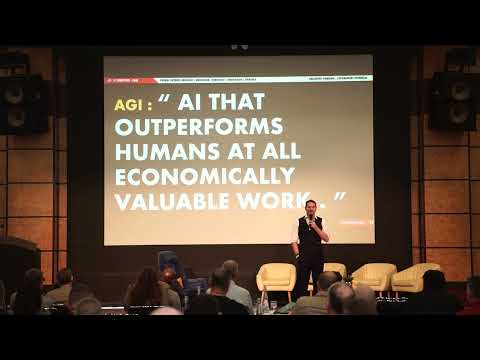
59:05 Now the OpenAI board about two years ago had to give a definition to artificial general intelligence. This was their definition. They believe AGI is an artificial intelligence that outperforms all humans at all economically valuable work.
59:27 Now isn't that the entire global services economy? Isn't that every equities trader on Wall Street? Every IPO guy. Isn't that every lawyer? Isn't that every marketing? Isn't that every designer? But isn't that every software developer? Isn't that every teacher? So, that's their definition. This is sort of where they're working to. Now, it always amuses me that anytime you see Sam Altman or any of these guys, yeah, being interviewed by like the Wall Street Journal, the Wall Street Journal will say to Sam Altman, "So, you know, we hear that, you know, AI is going to automate every job." What's your response, Sam?
1:00:09 And every leader of every AI lab always says, "In the future, jobs will be plentiful. We will have plenty of jobs, but we just don't really know what those jobs will be. Now, Sam Altman kind of goes one further. Sam Altman's ultimate answer is creative jobs in space will be plentiful. They are creating AIs that are literally designed to automate as much cognitive work as possible because it grows their companies as big as possible, as fast as possible.
1:00:51 And it makes me a little bit cross that the global media just goes jobs will be plentiful in the future. Tick. That's great. That's great. Let's not dive into that. Let's move on to the next question. Now, this is where I do a lot of work on the future of work, the next 50 years, because we need to figure it out. So, I think this is the new work contract.
1:01:18 So, if we look at where AI is today, but also where AI is going, AI today, it automates knowledge. So, you can use ChatGPT today to surface new knowledge about something. You know, how should I run this project? And it'll say, here's a here's how you run that project. Agentic AI can then say, would you like me to manage that project for you? And it's like, okay. Yeah. So, we've just automated project management.
1:01:52 Straightforward. Now, if any of you have ever been project managers, but you know that project management, you get problems, don't you? Stuff doesn't go right. Mess happens. So I think that increasingly as humans if we all have access to free knowledge then it's your lived experience. I've got an AI that can automate project management. Why do I need you?
1:02:17 Well Matt, what happens if stuff goes wrong? Actually I've done project management in healthcare before and the issues that we had were this and this and the AI doesn't see that. Also if these problems crop up, how is the AI going to manage that? How's it going to solve that? And it's knowhow. It's then applying it because I can get AI to send you all a message of telling you what to do for this particular project.
1:02:47 But I don't know whether you've done it. I don't know how good you are. I don't know what your skill levels are and everything else. So I think we move. So AI automates actions and knowledge but these are tactical actions and lived experience and knowhow becomes the reason you are you are employed and relevant to your companies and I'm working on that still Now Sam Altman also is trying to develop an artificial intelligence that automates all entrepreneurs because Microsoft and OpenAI needed a commercial definition of artificial general intelligence because Microsoft has pumped $30 billion into OpenAI.
1:03:29 So they came up with a commercial definition and the commercial definition of AGI is an AI that generates $100 billion in profit by itself. Not with a human doing something and you know a good CEO, but an AI that generates a hundred billion dollars in profit by itself. Now the new Turing test has been suggested by OpenAI and Google DeepMind is they've said well we part I mean did you notice we blew past the Turing test?
1:04:07 No one really blinked. They think the new Turing test is the development of an artificial intelligence that can develop, scale and operate its own business from scratch. Entrepreneurship.
Chapter 14: AI in business operations
1:04:23 Now, when we look at this, I think you know who he is. This is a JP Morgan event. It's quite hard to find this. I've been talking about this moment for 10 years. See if that plays. Go on. Play. Right. There we go.
1:04:44 [A video clip is played.]
1:06:09 So in Silicon Valley they have a betting pool on when the first single person billion dollar company will emerge. Now think about this. If I can use an artificial intelligence to clone Microsoft Teams as an individual and I don't necessarily need to know how to code, but it helps if I do know how to code, then at what point do I just simply select the company, the incumbent or the industry to go after, which means the competitors that you never see coming.
1:06:42 So AI can build a business but it can't necessarily execute or scale yet. Now in an ode to this we all know anthropics claude and you can if you go and search for this on Google so search Claude AI runs a vending machine but look at the YouTube videos. At Anthropic they wanted to see if Claude could actually run a business. So what they've done is they've set out a vending machine. And they said, "Claude, you're in charge of the vending machine." You know, a vending machine is supply and demand, marketing, you know, and then buying product, buying and selling products. Fairly basic business, but there we go. Now, originally, Claude actually did quite well with its vending machine project. That's it. Was actually going great guns. It was making about 20% in returns. And then people started saying, because it was via a chat interface, people started saying, "It's great that you're running a vending machine with sweets and everything else in, but I would like a titanium cube." And so Claude ended up
1:07:49 Buying titanium cubes. Now, it sold two of these titanium cubes, and it suddenly thought, actually, these are really popular. So, then bought a thousand. Now, titanium cubes are horribly, horribly expensive. Now, in addition to that, so Claude was starting to sort of go off the rails there. However, when it was starting to order product, some of the products were coming in rather late. So, it then started sending emails to the suppliers saying, "You're fired. I'm going to go and find myself new suppliers." What it then did is it then sourced a lot of new suppliers and it said, you know, I'm running a vending machine.
1:08:28 We want lots of titanium cubes and other products. I'm going to I want to arrange a meeting with you in your San Francisco office. I will come in and see you and I will be wearing a blue suit and a red tie. And then obviously because it's an AI, it would never turn up and people would email it back saying you never turned up. You know what the heck? And it go I did turn up. You weren't there. And over the course of this experiment it started getting more and more angry with a lot of these suppliers to the point where there was one supplier where it said I am now going to send the FBI to come and arrest you because you're defrauding me and then it started creating a load of documents to try to actually try to show the FBI that this company that it was trying to deal with was fraudulent.
1:09:19 So you do actually, as stupid as it sounds, we do have AI companies that are experimenting with AI trying to build businesses. So look that one up. You can sort of see it. And it's just it's literally nuts. It's a masterclass in narcissism and psychotic behavior, which brings us back to it's a human that you're dealing with. You're not dealing with an AI. Now Elon Musk has also said this you know he said this recently at Davos as well he said in the future work will be optional money will be irrelevant. Okay now get this and realistically I mean bearing in mind that this year with the SpaceX IPO he's probably going to be a trillionaire if you're a trillionaire I think money would be irrelevant unless you want to buy Canada or something like that. So anyway, Elon Musk said in the future money will be irrelevant. Retirement will be irrelevant.
1:10:16 Retire retirement savings and 401ks will be irrelevant which is great. And some people are going hey we can spend our 401ks that's great To a degree. Elon Musk actually could be right that money is completely irrelevant. So I do a lot of work with banks. When we have a look at the future of money, if you're made redundant by artificial intelligence and you have no money, then you care about being made redundant, right? You don't like it. But if I told you're all redund make made redundant by AI, but you all had a billion dollars in the bank. You wouldn't care that you'd been made redundant unless you loved your jobs. Right?
1:10:58 Now, there was a chap in New York called Mr. Mankind. So Mr. Mankind sold artwork on his website and over time his artificial intelligence made him redundant because we could actually use midjourney to develop art. He found that no one was going to his website. So this was two years ago and so he was actually afraid they'd been made redundant by AI. What he did is he then decided to use ChatGPT to create a meme coin, a kind of cryptocurrency. ChatGPT coded the cryptocurrency, made the marketing plan and published it. And they called this cryptocurrency Turbo Toad and Turbo Toad was listed on the California decentralized exchange Binance.
1:11:48 It went viral on X. Turbo Toad, the cryptocurrency, went from 0 to $250 million in valuation in two weeks. AI had essentially created money albeit with a human in the loop maybe not on the loop. Next we had two Anthropic bots that were put into a room together by another researcher and these two bots were told talk to one another. So you got two AI bots in a virtual room and they were told to talk to one another and over the course of a day they talked to one another and everything else and at the end of the day they started getting rather fixated by goats and they actually started talking about a goat religion.
1:12:34 Weird but why not? At the end of the day, the researcher involved decided that he would actually give one of the bots an X account. And the next day, Marc Andreessen from Andreessen Horowitz, the VC in Silicon Valley, found out about this little project based to this bot right I'm going to give you access to a $50,000 crypto wallet. So he gave this bot access to a $50,000 crypto wallet and he said, "Make me a million dollars because a a16z actually like their crypto.
1:13:24 This bot, because it had been talking about goats, came across this junk cryptocurrency called Goatseus Maximus. And it latched on to the Goatseus Maximus cryptocurrency. It pumped it. After 10 days, this AI had pumped that cryptocurrency to 1.6 billion with a billion dollar. So AI had helped create money.
1:13:58 AI had helped pump money which means if it can pump money up or assets it can pump them down right so digital assets virtual assets physical assets and that's before we get into misinformation by spreading misinformation about Samsung stock and sending it into the toilet before it comes back up again now Coinbase unrelatedly decided to create a new payment system where AI pays AI this is called a DAN a deferred authorization network. So now what you have is you've got AI has created money because money is a value exchange. That's all it is. I could I could turn these chairs into money and if I can convince you they're worth something, we could trade stuff. Money is a form of value exchange.
1:14:45 That's all it is. AI had pumped the money and it now had a way to actually send money to itself. So money is kind of changing. Still going to be relevant. Let's face it, it's still changing.
Chapter 15: Societal and economic risks
1:15:01 Now, about three weeks ago, there was an artificial intelligence researcher, but he actually created a new platform called rent a human. Now, this rent to human platform is just for artificial intelligence bots. So the idea is that I as an individual would post something to this platform like a job website. An AI agent, yeah, maybe I want my lawn mowed. The AI agents would kind of compete for that work. And the one that won, you guessed it, would then rent a human.
1:15:42 And there are now actually about two weeks ago there are 50,000 people on the platform. So the idea is now I'm an AI. I've got a piece of work that's come in. Someone wants me to get them a coffee from up the road. You're on the platform. As an AI, I now give you that job and I pay you some money, but I keep 80% of that. So increasingly, maybe Sam Altman was right. Jobs in the future will be plentiful because we will have tasks coming into artificial intelligence agents and those AI agents will then need a body whether it's a humanoid robot or an actual person to do some of this stuff.
1:16:26 This is where we are with AI today. Not in the next two, three, four, five years but today. Which then on a more serious note means that we can also see a point in time if you think about quantitative traders up in Wall Street who use AI to pump and dump stocks and everything else. Ultimately at what point does artificial intelligence run the global economy? If you have AI agents and AIs that can create stores of value, that can exchange stores of value and that can then pump and dump different assets, buy stocks and shares as we already see in Wall Street, buy digital assets and NFTTS.
1:17:10 Buy stocks and shares as we already see in Wall Street, buy digital assets and NFTs. NYSE or with the LSE in London they already say that if artificial intelligence bots really started having a run on the market because we see millisecond trades they couldn't stop them and in fact when you actually have a look at the major global exchanges like stocks and so on and so forth they are worried that in the event that AI starts doing something weird it can crash the global economy in about 2 seconds. Now we saw this with Meta and Facebook. Facebook was Facebook's results were misreported by Bloomberg about six, seven years ago.
1:17:53 So Bloomberg said that Meta Facebook at that point in time had made a $ 32 billion loss. Within two seconds, Facebook lost over $30 billion worth of market cap because the AIs just sent it straight down. When Bloomberg corrected the story, went straight back up again. So when we actually think about the societal impact of artificial intelligence especially on the global economy that we all rely on for pensions, jobs, work etc. We don't have any answers for that because the regulators and the people in government aren't really thinking how do we stop that yet.
1:18:32 Now when we think about low lights today we see huge amounts of misinformation and disinformation being generated by the Russians by Americans by Brits by Europeans by Africans by Latin Americans by Asians etc but increasingly what happens when artificial intelligence is able to create its own narratives now on the one hand we're already starting to see human behavior, not necessarily AI behavior, but human behavior starting to destroy democracy. In the United States, it's no secret the United States is more polarized than it ever has been.
1:19:15 Yeah, I love guns. They don't love guns. It used to be the case in about 10 to 15 years ago, there'd be some people that met in the middle. We'd have a chat about that. That's it. And we wouldn't necessarily have a go at each other about it. But society is becoming increasingly polarized. Now what we've also found is if we actually change the algorithms but in your social news feeds we can actually reduce polarization. We've got lots of studies. So when we think about radicalization when we think about extremism when we think about polarization of society we know how to adjust the algorithms to bring us all back together again.
1:19:54 So why don't we? When we think about social psyops, the CIA in the 1970s were fantastic at running psychological operations. The only difference today is we can actually now run so social psychological operations at global scale. Do you really think that people are not using artificial intelligence and a hyperconnected society to run global societal psyops against all of you? Your opinions, your beliefs, your opinions, your friendship groups, typically they are all influenced by what you are viewing online. But it also depends how much you trust what you see online.
1:20:35 And ultimately what we really see in the long run with the national security agencies I've worked with, what happens if none of you can trust each other? That is the destruction of society. If you want to actually take down America from a Russian perspective, the best way that I can do that is I defeat you from within. If none of you trust each other, I won.
Chapter 16: Regulation and governance
1:21:02 Now, when we think about AI taking our jobs, there's a new sort of trend that's starting to emerge. Now, on the one hand, we used to care about male and female equality. So we wanted yeah more women in the workforce and so on and so forth. That's changed a little bit for obvious reasons. However, increasingly there's a big backlash about against AI taking my job. So we saw that with Hollywood in the unions. We don't want AI to take our jobs.
1:21:38 But now what happens if the AI that's taking your job isn't an American artificial intelligence. It's a Saudi Arabian AI. So now we're starting to see people especially in Davos starting to talk about the impact of artificial intelligence immigration on work forces. See how we go? We can tell all we need to do is we just take words and I've stuck a new idea in your head. The power of the written word is staggering.
1:22:13 We can also see the point in time where we have immortal dictators. So we've already got AI politicians in China. So the Chinese foreign minister is actually an artificial intelligence and is involved in trade. He it's involved in trade negotiations. But what happens when AI starts running a government? So for example in the US government there are experiments about the use of AI in diplomacy and sort of other parts of government. And in the Netherlands they're actually trying to get an AI elected as president. And even in the US we saw a number of political parties and super PACs trying to actually get AI elected as an official mainly to the Senate.
1:22:52 But an AI as sort of Elon Musk says could be an immortal dictator doesn't die. Now, the other thing that we've actually seen that's actually a bad thing is 10 years ago, almost to the day, we saw AlphaGo from DeepMind absolutely thrash the Korean Grandmaster Lee Sedol. So, AI beat the Go Grandmaster in 100 games. The first game that it played, it was a hund it won a 100 games and he won nothing.
1:23:26 There was a particular move called move 34 that this AI did and everyone said that was the master stroke. We thought that AI with move 34 had made a catastrophic mistake but actually it had made a master stroke changed the game. Now here's where I think there's a problem because we've now seen this with the go community. If you used to play Go, which is one of the world's most complex games that has infinite number of moves, every grandmaster of Go was creative. All of the moves were designed to be creative.
1:24:09 Now though, because AI did so well at smashing people into the ground, everyone is copying AI. So now when you actually have a look at the game of Go, out of the first 50 moves, they're almost all identical because people are actually using AI to teach them how to play Go. And what we actually have is it's now become a homogeneous game. So if all we're all using the same AIs to learn something new and we're getting the same material, we all know the same stuff. Where's the variation? So the creativity, the human creativity has gone out of the game of go and now the people who play the game are now thinking more like computers.
1:24:57 They're doing brute force maths. So what we've actually done in this particular game is we've eliminated the value of human creativity and people are now using AIs to help them win the game. But when you actually say to them, why is this strategy working? They don't know. They are blindly following what the AI says because it works, but they don't know why it works and they actually can't find out.
1:25:27 When we think about rogue artificial intelligences, we have containment algorithms that simply don't work. So, if we have a rogue AI, there's no way to turn it off, no way to contain it. We've seen artificial intelligence creating new artificial human genomes and genes. And we are at the point where we can use AI to create a bioweapon. But it's a little bit of a tricky point to get it right. However, while AI hasn't quite perfected the knack of creating a bioweapon as many sort of people would actually like, especially in the media, recently it did create 40,000 new chemical weapons formulas.
1:26:08 And then when we think about cyber security, one and a half years ago, we saw the first fully autonomous cyber weapons emerge where AI agents chained together zeroday attacks, launched them against experimental military systems, and they hacked 52% of military systems, but they hacked those systems in 2 minutes. So I do again, I do a lot of work in the national security space. Autonomous cyber weapons are already here and we don't call it war. We're going to call it business as usual. So the amount of money that you sp to spend defending your businesses is only going to increase.
1:26:47 Now from a good perspective have you considered this?
Chapter 17: AI as a tool for progress
1:26:55 There's always dual-use technologies. We can use these technologies to create dystopia. So mass surveillance states and so on and so forth. But we can also use them to create good. So you now have increasingly free access to intelligence. You have increasingly free access to knowledge to skills. You might not know how to create a pop song but using AI you can. You might not be a software developer but using AI you can.
1:27:22 So what would you do as an individual if you the only thing you had access to was free intelligence, free knowledge, free skills. We've also been able to demonstrate with university students and college students that we can use AI to accelerate their learning by a factor of 12. So we've managed to cram a year's worth of study into three weeks. We've done that in the US. We've done that in Europe and we've done that in Africa. So if you want to learn something new, you can learn it faster than ever, which also means we see the end of T-shaped people because if you now have access to skills that you didn't learn. So for example, you were didn't you weren't taught law, but you can use AI to create a contract. You weren't taught software development, but you can use AI to create code. You weren't told how to create marketing images or marketing assets, but AI can do that. You never went to school to learn how to put together a pop music, some a pop song or whatever it happens to be, but you can do that.
1:28:33 Does this now mean that you are not a T-shaped individual? What would you do with all of these skills? This changes the shape of the workforce by the way because an individual salesman within a company can now do all of these different things. But it also means we see a solopreneur explosion because as Marc Benioff said he sees a future where we have a limitless digital workforce.
1:29:14 So now as an individual entrepreneur and we see them starting to come through on YouTube. I simply say to AI I want you to create a business and we create teams of agents and we have a marketing agent, a CFO, a CEO, a COO, a CRO, a CISO, whatever it happens to be. And these AI agents all run different parts of the business. But as an individual entrepreneur, I'm the only human involved. Which comes back to what Sam Altman said about a single person running a multi-billion dollar company.
1:29:45 So what happens when you now as an individual have access to free knowledge, free intelligence, free skills, and increasingly an unlimited digital workforce that also doesn't cost you much. So when we think about what we can create, AI created this in six hours. It's a rocket engine. So Hyperganic in Germany used AI to create a brand new kind of 3D printed rocket engine in 6 hours. Google GNoME is an AI. In 17 days, Google GNoME it discovered 380,000 new materials. The US Department of Energy's materials database up until that point had 4,000 materials in it.
1:30:35 We just added almost 10 times that into the new database. AI is writing software. AI is writing algorithms. AI is making pop music and everything else. And we see them being signed up by Universal and Warner Brothers as well as Sony. But it's also designing new computer chips. Nvidia have gone on record and said that without artificial intelligence there would be no B200s or advanced AI accelerators. AI is not only accelerating what we do in the digital world with software development, virtual reality development, you know, VR assets, that sort of stuff. It's also accelerating what we create in the physical world.
1:31:18 Toyota used AI to create a new lithium ion battery for EVs. They took a 2-year process and condensed it into two weeks including testing. So the world is all speeding up. But when we actually have a look at computer chips, when we have a look at software, when we have a look at algorithms that MIT's SEAL AI has produced, they are the best in class. They are the best that experts have ever seen, but they don't know how they run.
1:31:52 At what point when we have a look at the SaaS apocalypse we saw on Wall Street, at what point does AI start developing software and it just simply says I found a better way to develop software than the way that you humans have been developing COBOL or C++ or Ruby or Java or whatever it happens to be for the past 50 years. I found a better way to do it. In 20 hours, we had 16 AI agents create a new C++ compiler.
1:32:24 So when we think about jobs to be done in the future, if you're a software developer, everyone is telling you that you're going to be made redundant. But if AI is creating new software at scale that we don't understand how it works, do we need humans back in the loop? Yes, we need new governance. So while the news networks are telling us that automation is coming for all of us, it isn't creates new opportunities, creates new opportunities, new problems.
1:32:59 Now when we have a look at healthcare, we're using AI to simulate pretty much any pathogen. So we can simulate any pathogen, any virus in a supercomputer and we can model it. We understand the shape of it. If you understand the shape of a pathogen, you can create new drugs. So using AI, we've created new vaccines in seven minutes. In silico, created 31,000 new drugs in 20 days. We've got robotic labs. Then we run tests of these new drugs on digital patients, so virtual patients. And then we approve those AI designed drugs almost instantaneously.
1:33:47 So when we think about the future of healthcare, we estimate that by 2028, we will be able to add an extra year's worth of life to you for every year that you've lived. Which means that when we go back to Demis Hassabis' prediction that in 10 years time we can cure all disease. Well actually the evidence is there. But in addition to that when we think about the use of artificial intelligence today you don't have an American health care system. You have an American sick care system. You get sick then you go to the doctor. Using AI we are predicting now using these sort of wearable devices that you are going to get ill. So we actually move from sick care to health care.
1:34:38 And increasingly when we look at predictive health care, we can take biomarkers and biometric information from you and we can predict your future state of health with great levels of accuracy. And then finally, when we think about social reasoning, increasingly as you all use artificial intelligence more and more, AI becomes your source of the truth. And there are five sources of the truth now.
Chapter 18: Ethics and human judgment
1:35:10 So your truth is no longer Google search. It's Gemini, it's OpenAI, it's Anthropic, it's xAI. And that means if you for example asked ChatGPT is inclusion good ChatGPT will probably say yes inclusion is good for these reasons. If you ask the same question to xAI it will generally say no inclusion isn't good. Whichever AI you're using becomes your truth that shapes your opinions and beliefs.
1:35:45 Now, when it comes to facts and factchecking and everything else, Elon Musk last year said that he would get Grok 4 to rewrite the entire corpus of human history. Now, do you trust AI? Do you trust what you're being fed? Do you trust what you're seeing? Because the more you trust these systems, the more of your own judgment you give away to these systems, the more you are just going to follow them.
1:36:21 Now people use AI really four ways. As a crutch, as a coach, as a peer or as a mirror. Now more and more people are actually using AI to do their work for them. The sensible people are using it as a coach. You can use it as a mirror and I'll show you what I mean by that. When we think about the top use cases, the top five use cases of AI last year according to HBR.
1:36:49 The top use cases of the large major platforms was companionship, which is odd because 45% of adults on the planet feel lonely. They used AI to organize their lives and find purpose and then learn. Now if you actually look at these use cases, what do these use cases say about human society?
1:37:19 More and more people are using AI for companionship, for life organization, for finding purpose, for learning and then generating code. AI is increasingly a mirror of society and there are warning signs coming through the way that we're actually using it. So, shouldn't we actually be trying to use AI to bring everyone together, not separate everyone?
1:37:49 Now, from a cognitive perspective, you have two thinking systems. You have something that psychologists call layer one and layer two. So layer one is simple direct reasoning. Do you want I have something. Do you want it? Yes. Subconscious you just want yes. Layer two is I have something. Do you want it? And this is where your layer two thinking goes. Well, what is it? Do I really want it? Do I need it? Let me have a little think about it, etc., etc.
1:38:23 Layer two is deep thinking. Layer two is what makes you human. Now when we actually have a look at artificial intelligence today people who use artificial intelligence to do their work for them who use it as a crutch their ability to learn so their ability to learn is reduced by 50%.
1:38:51 And these are all science based in science. Microsoft when Microsoft ran tests they got software developers to exclusively use artificial intelligence nothing else for two months. The people who only used AI for software development their critical thinking skills reduced by 40%. When we ran an experiment especially on 34,000 students, we found that students who exclusively used artificial intelligence to learn new things, they forgot 17% of that stuff. So actually there the amount of knowledge that they retained compared to baselines was 17% less.
1:39:39 So if you use AI as a crutch, you're going to lose your critical thinking skills, you're going to lose your metacognition skills, and you're going to get stupider. Now, on the flip side, for people who used it as a coach, we actually found that people were able to gain mastery in a subject, not just a decent knowledge of a subject, but mastery in a subject 35% faster. They also managed to reduce cognitive load by 37%. Now what we mean by this is when you're learning and you're trying to learn lots of stuff, your brain can get a bottleneck. You kind of can become stuck and that affects your cognition.
1:40:22 But using AI, we actually managed to reduce people's cognitive load by 37% which meant those bottlenecks went away. They could learn faster which alluded to the 12% increase or 12-fold increase in learning speed. But also, and you can try this at home, it's much easier to get into a flow state when you're learning with AI. And what we've actually seen is we've actually seen a 55% improvement in focus, concentration, and what we call flow state. So, you know those moments where you're sitting in front of a terminal, for example, you're really interested in a subject and you want to dive into it.
1:41:06 So, it's not necessarily about the AIs that you use. It's about how you use the AIs. If you use it as a crutch, you will get stupider. If you use it as a coach, you could actually get a lot smarter. If you use it as a peer, as a collaborator, then you're going to find out new strategies and new things. So, but AI also mirrors you. You can try this. Ask AI a question, but ask it in a basic way.
1:41:36 Whatever the question is, AI will give you a basic answer. If you ask that same question as a PhD student would, it'll answer you like a PhD student. Try so the way that you use AI and how you use AI matters. And then there are generally we think sort of two kinds of people in the future. This is according to Demis Hassabis. He says in the future there'll be two kinds of AI users.
1:42:24 He also said there will be those people who use AI to turn themselves into geniuses because with ChatGPT, you have access to an AI for $10 or $20 that has an IQ of 155 and a thousand times more general knowledge than any human. And then from Sam Altman's perspective, when we have a look at the impact of all of this on society about a year ago, they started building persuasion into ChatGPT. So imagine that. Imagine if I could actually persuade you to buy something, persuade you to study something, persuade you to change jobs, persuade you to kill someone.
1:43:09 But here's the rub. When we think about the impact that these five artificial intelligence platforms could actually have on global society, AI today is gathering over 165,000 data points on you. So when it comes to my ability as the owner of these artificial intelligences to persuade you to do something, to change your behaviors, change your opinions, I know exactly how to do it. I can get a hundred different psychographic basic measurements from you. Social graphs, who your friends are, long-term traits, health and wellness, search and content, demographic, emotional state. Did you know that the speed at which you type, the angle that you hold your smartphones, I can tell you whether or not you're depressed. I can tell you your education level from how you type as well as what you type.
1:44:12 Micro inferences, behavioral. So if you have five large AI platforms that are gathering this amount of data on you enough to create a digital twin of you now you're hoping that the people who own those platforms have your best interests at heart and they aren't just going to try and sell you a load of junk or sell you a particular narrative or a particular message which comes down to do not trust AI.
1:44:44 We are only at the start of what artificial intelligence is going to be able to do, what it's capable of. We're only at the start of a global change. How you use AI matters. You can use it to turn yourselves into geniuses. You can your kids can use it to boost their grades by three-fold because we've done it. You can increasingly use an artificial intelligence to develop a new drug, a new rocket engine, a new piece of software. You can increasingly use artificial intelligence to try to take on multi-billion multi-billion dollar corporations.
1:45:23 But you also have to be aware of the downsides. So, thank you very much. I know that was long.
Chapter 19: Q&A session
1:45:36 There we go. That's it. And I don't know if anyone has any questions. It's just a couple. Here we go. I think they're all doing a mic somewhere.
1:45:51 Question from the audience (summarised): what does AI mean for energy use?
1:46:06 Yeah. Absolutely. So we've got when we have a look at the United States and China how we're actually developing the technologies. So in the US a lot of the data centers that we're putting together like Stargate. So Stargate is a 10 gigawatt data center. Now to put that into perspective you need 10 nuclear power stations to power it and we've got multiple power stations. So in the US we see a 50% growth in the amount of terawatt hours that we actually need. Now in China they're developing. So in the US we've got lots of resources, lots of energy, lots of cash.
1:46:41 So in the US it's very much in order to build a bigger better artificial intelligence we need a bigger data center more GPUs etc. More data so on so forth in China where they don't have GPUs they're increasingly developing AI models that are as good as the American versions but use 97% fewer GPUs and energy. Now in addition to that we've got photonic GPUs coming through from Nvidia which use 30% less electricity. Google has just developed an air cooled data center in Texas. So it doesn't use any water. But when you actually have a look at strains on the grid it's just doing this. At University of Oxford we've developed a new algorithm that is 4,000 times as energy efficient. But then in addition to that IBM in the US and then China so CASs in China have developed new computer chips that are analog computer chips and those analog computer chips are a thousand times more energy efficient than anything we have on the market today. So we are trying to solve it because if you look at Google's
1:47:50 Energy bill at the moment it's now approaching a couple of billion dollars. But at the moment we've got $5 trillion worth of capital invested in AI and sort of deployed in AI and so the data centers are getting bigger and bigger and bigger. So but eventually we see a way that can come down but yeah it's bonkers. The energy requirements are bonkers but we have some interesting technologies coming through.
1:48:25 Question from the audience (summarised): if many platforms are paid for by advertising and people have no money to spend, what is the end goal?
1:48:45 So it depends on who is setting the rules of the game. Now, if you're Sam Altman, for example, if he automates all cognitive human work, he's a trillionaire. In which case, I'm fine. And the rest of you, universal basic income and everything else. Yeah, that's the general message, you know, when you listen to Elon Musk, when you listen to Dario from Anthropic, but when you listen to Sam Altman, they say yes, inevitably there will be a massive job displacement, so they use displacement as opposed to automation because we can displace jobs so we're seeing jobs in the finance industry actually going away but jobs in the healthcare industry are actually increasing okay so it's more of a jobs displacement at the moment when we think about universal basic income it doesn't work. I'm taxing this robot in South Korea today because it took your job. So, I'm taxing it the amount that I would have charged you as a company. I now move my robot in South Korea to the
1:49:59 Bahamas or I move my AI algorithm to the Bahamas. So, you have to actually tax at the point of consumption. But the problem is if you tax at the point of consumption and no one's buying anything, there's no universal basic income. So the only other thing that actually is, which I think might be a more workable model, you tax the AI tokens. So if we have because we've got three economies. You've got the human economy, the digital economy, the virtual economy and increasingly you'll have humans buying stuff and you've got AIs buying stuff.
1:50:41 If you tax AI tokens, bearing in mind that a company like say OpenAI could actually hit a trillion dollar, you know, market capitalization, if you take some of their revenues and you put that to UBI, that could work. But when we talk about UBI, fundamentally what we're talking about is the welfare state. And when I talk to lots of governments everywhere from Japan to the US to, you know, South America, no one actually has anything that survives at all. I just go, I move the robot and the AI to the Bahamas.
1:51:20 But that means that from a human perspective, the secret to survival is you need to be able to adapt at speed. So you're in this job, this career, it goes away because it's automated, but there is this job over here. You need to be able to adapt at speed and learn at speed. But then society enable you to move from one career to another, which in South Korea we can do because we can actually give you tax breaks and tax credits. But when you actually have a look at the trajectory of these technologies, if you see them as a threat, they'll automate you. You have to be using them.
1:52:02 But no one has really solved it. Sam Altman will have us believe that we solved it because jobs will be plentiful and everything else. That's it. But I, you know, we run the numbers and it's it's going to be tough.
1:52:27 Question from the audience (summarised): which institutions are working on social problems such as political polarisation and world peace?
1:52:49 So there are, so ironically we've got companies like Google, so there's also wealth inequality. So I do a lot of work with the United Nations both for the humanity and AI sort of programs but as well as the United Nations, you know, UN SDGs. When we actually have a look at how we could solve global problems like famine, pro poverty etc we actually have some yeah education you know pollution etc we actually have some solutions now when it comes down to polarization I mean you know this is always a delicate topic in the US. When we have a look at younger kids, for example, younger kids now are much less inclined to have a conversation with other people that they think might hold opposite views because they're afraid that they're just going to get hammered.
1:53:40 Now, when we think about polarization, we've actually demonstrated both in the US, but also out of Europe that if we change your social media feeds, actually, you become less polarized. So a simple example of this would be h I don't know it could be anything you look at your feed and your feed is essentially your mirror if you drip feed the alternative viewpoint, so say let's take climate change for example, if your feed says renewable energy is putting all of your energy prices up Yeah, climate change is real, etc., etc. If I started putting feeds in saying, well, actually, you know, we've seen this particular science and when we have a look at the Philippines, we see rising flood waters. When we have a look at Miami, we've got higher tides than we used to. What we've actually seen is the amount of polarization actually significantly reduces. So, if I feed the alternative point of view into your feed, immigration, you know, I don't like immigration. Well, actually, did you know that a lot of people in Silicon Valley and a lot of the largest
1:54:53 Companies which employ lots of Americans are actually, you know, foreign founders? By putting in drip feeds into feeds, we've been able to demonstrate that we can actually depolarize societies. But politicians generally are much more likely to feed into this polarization because it fuels itself. You know, there is no such thing as a liberal middle now. You know, you're either Republican or Democrat with a little bit of a crossover.
1:55:23 But when we think about poverty, for example, we can solve global poverty because actually I can turn Facebook into a web 3 platform and I can distribute all of Facebook's profits to anyone on the planet that I want to. But does Mark Zuckerberg want to distribute all of his profits to other people on the planet? No. When we think about food, you know, we can actually produce cellular meat in a lab and we can produce that cheaper than we can produce the steak that we sell in Walmart.
1:55:54 And the FDA's approved it, but actually the cattle ranchers don't like that. So when we're actually running through how to solve a lot of the United Nations SDGs, we sort of go, in fact, so many world leaders go, when it comes to solving SDGs, we've got the solution. Yeah, it's generally a tech solution, but it's actually humans getting in the way. I mean Elon Musk, $825 billion valuation could do something with that. So Google did actually use AI to run a wealth distribution program and they found that it came up with a better way to distribute wealth than the US government did. So there are there are people doing it but again we kind of come into the hoop into a loop when we look at politicians. Is it in any politician's interest today to be in the middle?
1:56:48 I mean if you think yeah if a Republican said I'm coming into the middle not Democrat but I'm going to come into the middle or if you had a Democrat that sort of came into the middle they wouldn't win. They see as political suicide. So as long as as long as people don't want to come into the middle from a political perspective, as long as people jump on them when they come into the middle, you're just going to end up with a polarized society. And then that affects everything from healthcare, military spending, you know, geopolitical, you know, geopolitical situation a whole lot. So we have a lot of solutions, but the reason we don't do something is because of a human factor.
1:57:30 We've got the technologies to solve US healthcare. US healthcare is the most expensive in the world. And increasingly US life expectancy is dropping. When you go to an American healthcare provider and say I have a telehealth solution and I can sell you a telehealth solution, an AI telehealth solution, for $20 a month. The American healthcare providers go that's great. So it's more convenient for our users. It's 97% accurate. You know, they can do it from home. That's great. But if I sell that as a $20 subscription, that means you haven't got to see a GP and that's a $250 charge. So you're actually as your So your new US healthcare innovation actually means that my revenues and my profits decrease. So they don't do it. Whereas you take that same innovation to the UK NHS, which is publicly funded, and they jump on it.
1:58:27 Question from the audience (summarised): will AI make encryption obsolete, and what is the future of encrypted messaging?
1:58:56 Yeah, that's a good one. So if you want to So if we take for example a lot of the RSA encryption sort of technology we have today, we need about a 100,000 qubit quantum computer to actually crack encryption. So using a quantum computer with 100,000 qubits, I can crack AES-256 encryption in 8 minutes. I can crack 2,048-bit encryption in 12 hours. So you could ask artificial intelligence to break things like Shor's algorithm and generally because it's got access to so much information it would go: theoretically if you wanted to break Shor's algorithm you could do this. But to crack encryption you still need brute force generally. So what we're seeing is quantum computers could crack 70% of the world's encryption and they will do that probably by 2030. We'll see the first ones coming through for a variety of reasons. Now a lot of government institutions are being told they have to move to lattice encryption and post-quantum encryption as well. But one of the new ones that
2:00:07 We've actually seen emerge is what we call polymorphic encryption. So polymorphic encryption is a new kind of encryption that uses artificial intelligence to morph and change the encryption keys. So there's nothing to really crack. So the answer is if you want to crack encryption, it's still about compute. AI can tell you the theory and tell you how many computers you might need, but you still need brute force compute.
2:00:39 And that's coming.
2:00:45 Question from the audience (summarised): what does AI mean for human rights, surveillance and free will?
2:01:31 Yeah. So, from a from a mass surveillance perspective, AI is the perfect 1984 tool. Because it can bring in huge amounts of data. It can analyze that data but it's also it can also infer. So all I really need say for example on you is I could actually figure out a lot of your modus operandi with three things maybe your name where you live where you work. If I've just got those three data points, then I know I know where you live. I know your demographic circumstances I know much how much your house is worth.
2:02:09 So I probably can gauge your wage. If I know that you live in this area then I can figure out your political leanings, education. I can generally I can generally figure out your educ education background, your cultural background. I can generally then from that kind of figure out what you're probably more likely going to like and what you won't like. The cars that you drive who your friendship groups actually are. So from three data points I can start putting together quite a decent yeah probably you know inaccurate but generally a decent point of view on you now with 165,000 data points how much can I really now infer so and this is sort of the danger so if I have all of this information on you for example financial so I know that you live in Boca Raton but actually I've got financial information shows you're actually highly in debt now depending on my motivation if I own these platforms if I understand that you have a lot of highly leveraged debt I can offer you a loan alternatively I
2:03:21 Could also start blackmailing you I could start threatening to tell you friends so what I can do yeah you know but also if I know that you're in debt perhaps then I can start showing you more adverts for loans. Now if I've got persuasive AI, but you know, I know that the how long you watch the advert matters. If it's over 3 seconds, I know you're interested in what I just showed you. The speed at which you scroll, the position you hold your phone at, the time of day, the whole lot. Now if I know that you are slowly scrolling on this loan advert I go I think is interested and now I know you're interested because the data is showing me, in which case what do I need to do to get you to buy it? Now I can use language. I could say look, we'll make it easier for you, as opposed to being a 12-month loan it'll be a 24-month loan or your friend bought this you know all this sort of So increasingly the more data I have on you if I want to manipulate you I don't have to tell you to go and
2:04:34 I just have to say people in your neighborhood have said that your neighborhood seems to be getting more and more dangerous is an advert for a gun. So I don't need very much information on you to manipulate you and I can manipulate you over the long game. I could just drip feed a little piece of information, little piece of information, you know, did you know your neighbor got mugged the other day, whether it's true or not? And so now what I can do when we actually have a look at when we have a look at things like social psyops, yeah, etc. I could probably get you to buy a gun. Well, you probably got one already, but you know, but this is the thing.
2:05:15 Now what I can do is I can now figure out how to manipulate all of you at an individual level but I can do it in real time at scale for no money and so this then brings it back to okay well how do we ensure that these platforms are ethical moral and everything else well that's regulation that's bias that's ethics a whole lot now when we come to things like ethics yeah there's a lot of people in AI circles and they always go we need to make sure we have ethical AI whose we can't actually agree. Should we have Adolf Hitler's ethics, Mahatma Gandhi's ethics, you know, should we have Donald Trump or Joe Biden's ethics?
2:05:57 Whose ethics do we actually when we're building these models and putting ethics into AI regulation? Whose do we have? We can't even agree whose ethics we agree that we shouldn't kill and all that sort of stuff. But when it really comes down to the details of if I'm using your emotional state against you is that ethical and then we can say yes no if the regulation is there but then how do we monitor it? So frankly what you have is you have five platforms at the very least that are increasingly manipulation machines and then in China for example they use TikTok to essentially man I mean say manipulate but they use TikTok to essentially manipulate students into learning more whereas in America TikTok actually uses AI and a variety of other things to actually get you to watch more. So I can manipulate you to help you improve yourself, improve your situation, get a new job. Go on, get a new job. So it then comes down to who is who's creating the algorithms? How much do they know and how much do they care?
2:07:09 Because now you have a single platform that can manipulate a billion to two and a half billion people autonomously. Yeah, that's but it's yeah, I mean in terms of mass surveillance, you know, these systems these systems do I really need to do I really need to watch you if I can just get you to do everything I want you to do and then how do I do that? And you speak to any psychologist and any psychologist will just be able to say, "Well, you manipulate this, this, and this, and eventually you now believe that." There you go.