Chapter 1: Introduction
0:12 How are you all? You all good? All good. Excellent. We're going to do a little bit of a question. How many of you in here run a business? So, you're entrepreneurs. Okay. How many of you are leading businesses? Go. Excellent. My presentation is all about giving you an incredibly unfair advantage in the global marketplace. So, my name is Matthew Griffin. I'm the CEO and founder of the 311 Institute.
0:49 We're a global futures and deep futures organization and I compete with McKinsey, KPMG, BCG, Ernst and Young. I started a company a little while ago as a one-man band. So, I'm very very serious when I say I'm going to give you the unfair advantage. The way that you build products, go to market, think about your customers, think about your staff, hiring, retention, learning and development, skills development. Forget it.
2:22 What we're going to do is we're going to show you the new way to do things.
Chapter 2: The evolving global landscape
3:49 So, this is my little agenda. We're going to go through the future of artificial intelligence because this matters. This is where you get the advantage, but it's not going to be what you think. Three approaches to how you think about developing your business. Get ready. Go. Call to action. So, let's go. Now, when we think about the world around us, there is actually only one thing that's changing. And for most of us, we can get our heads around one thing, unless it's this.
4:24 Now, when we actually have a look at, for example, one of the surveys that was done earlier in Lithuania, you're growing GDP at about 3%. People are a little bit more pessimistic about the future because it's increasingly uncertain. So, that's what the slides earlier showed. Part of the reason for that is because everything is changing. Everything is moving faster. This is your opportunity because if everything is changing, people are looking for companies that can help them with those changes. Right?
5:01 In the 1970s, the United States military coined the phrase VUCA, volatile, uncertain, complex, ambiguous. But today the changes that we see are max. They are massive. They are system level. They are global. So think about the impact of technology. The impact of artificial intelligence is global. We have the United States trying to keep China in a box with Europe trying to do a variety of different things. Geopolitics is having a global impact. The power plays. When we think about military, we are seeing the remilitarization of the world with Russia to the north, NATO expansion.
5:49 So the changes are massive. When we think about the economy, we see the dollar declining because we see the global economies splitting into two with the BRICS. Europe is a block, USA is a block, Southeast Asia is a block, Latin America is a block. I work in a hundred countries. So I see all these changes and people are looking for people who can help them. Everything's accelerating. I'll go through that in a little bit. But you can have a look at your own lives whether it's as an individual, as a professional. You can see your industries changing.
6:28 You can see your country changing. You can see Europe changing. You can see the world changing, right? But it's all changing faster and faster. Speed is your problem, but speed is also your opportunity. And then exponential because the changes are exponential. We have exponential technologies and I'll go through those. So the speed at which I can understand a customer need or a problem to solve the innovation dilemma. The speed at which I can create a product.
7:40 the speed at which I can identify a problem to be solved, create a product, for example, software, and then get it into the market and then train my sales guys up to sell these products, create the marketing materials, the business vision, the business strategy. It's all accelerating, but the cost of doing all of that is dropping to zero. you have more opportunity than you ever thought imaginable. So when we think about the future of artificial intelligence,
Chapter 3: The intelligence transformation
8:17 this is the speed that we're dealing with. When OpenAI released GPT-5, when Google Gemini 3 was released, it was available to everybody on the planet in 69 milliseconds. So, as these artificial intelligences get better at what they do and what they help you do, you have instant access to whatever those new skills are. So, for example, Anthropic's Claude 4 cloned Microsoft Teams in 30 hours. And when we have a look at the future, we'll be able to clone TikTok in 30 seconds. What do you do with that unfair advantage?
9:12 Which is why I go back to what I said earlier. The way that you did business is dead. If you have a new mindset, all of this lets you out compete every single company in Europe and every other company in Lithuania. Increasingly, as organizations, we are not going through a digital transformation. You're going through an intelligence transformation. Now what I mean by this is as you start using AI more in your companies, AI takes information in, analyzes it and if you give AI the ability to act or decide on your behalf, you're undertaking an intelligence transformation.
10:08 This is a different kind of technology stack, different partners, different investment, different job roles within the business. And artificial intelligence is increasingly moving from helping you automate your business to run your business for you. It's moving from automation, so robotic process automation to autonomous. And the difference between an automated system is very different to a system that is autonomous. They are increasingly identifying the problems to solve, creating the products, creating the marketing plan, creating the assets, and then doing the sales and then doing the procurement.
11:05 etc. and doing the compliance. There's a difference between automated and autonomous and we're moving towards autonomous.
Chapter 4: Capabilities of modern AI
11:23 What we're trying to do is we're trying to develop foundational artificial intelligence systems that are intelligent like human intelligence. So they measure the foundational models basically are measured on IQ. GPT-5 was trained on emotional intelligence EQ because increasingly we want these AIs to be able to understand the relationships and behaviors of people. So think about your customers. You can ask these AIs, why did my customer do what they did?
12:03 And increasingly it will say, well, based on the communications that you had, the language that they used in the first couple of emails, they weren't committing. It was flaky. It was iffy. It was a fob off. Then we move to action. So AQ is really where we use agentic artificial intelligence to do actions and things for us and we're at that sort of point at the moment and then SQ is social. So increasingly we're teaching these artificial intelligences to be social. So for you you can see it today if you think about the AI increasingly in the future they're going to be talking to you in a very similar style to other humans other people.
12:49 conversational, social. Now, if you think about the advantage of a social artificial intelligence within, for example, customer service, sales, leadership as well, it doesn't just sort of stick in that customer service space. There's advantages to that, but that's where we're going. Now when we think about agentic artificial intelligence, we can have about a hundred people working together within a company to get things done. With AI, we can get the equivalent of a thousand people working together to get things done, but they cost pretty much nothing. They run 24/7. They have problems. We can hack them. They're difficult to manage and govern. They have their own behaviors. They've created their own protocultures.
13:46 So, there are difficulties with agentic AI. It's not all just beneficial. But nevertheless, if you have a thousand agents collaborating across your business, they're starting to run your business. And we see more and more startups out of Silicon Valley that are going to billion dollar valuations. and they will have three people in the company. Now, how many of you have actually used AI like ChatGPT, Claude, Gemini 3? Here we go. Yeah, everyone. You all have. There we go. This is what you've been using.
14:26 So, these are the official studies. Did you know that ChatGPT has a verbal IQ of 155? Google Gemini 3.0 has an IQ of 136 because we've measured it. Now, they aren't necessarily directly attributable to human intelligence, but we like anthropomorphizing sort of technology. The average human IQ is 100. So, you are automatically every single one of you using an AI with an IQ of 155.
15:03 Next year, we think that'll be about 300. 200 to 300. They have unlimited memory which is advantage later. They have a thousand times more knowledge than any human. This is why you can ask ChatGPT to write you a code, an application, write you a project plan, analyze a market, help you with a recipe, help you create a floor plan for an event. They have sucked in all of the information on the planet, all of the public information.
15:41 So you have access to the equivalent of a thousand Einsteins. So when I talk about an unfair advantage, that is not incremental, that is highly disruptive provided you know how to use it properly. I'm not kidding. And their learning speed at the moment is 300 million times faster than any human. And when we actually think about things like ideas and novelty, they're coming up with some good new ideas using AI basics that I create. What's good about them? What's bad about them?
16:29 How would you improve it for this market? And increasingly they are starting to try to learn new skills very quickly. We see them coming for soft skills. We've done that with EQ and SQ. And we see them coming for hard technical skills as well. And we see that with Claude. And when we think about hard technical skills, we've seen $2 trillion dollar wiped off the United States stock exchanges.
17:02 Because AI is increasingly coming for software, hardware and other industries. Claude, so Anthropic, recently released an AI that was designed to compete with human lawyers and law firms. It wiped 20% of their stock values off. What happens when you have access to a lawyer for free? So, think about how your legal teams get stuck. You've done a sale, you're putting together a EULA or a software contract for a customer. How long does that process hold you up? How much does it cost you?
18:01 What if you could get all of your contracts analyzed, vetted, done, and returned to the customers within 2 minutes? This isn't just about front-end sales. This is about a horribly disruptive competitive advantage across almost all of your business areas.
Chapter 5: Future AI developments
18:22 The next generation of artificial intelligences this year will be neurosymbolic. So this is where we combine reasoning AI with large language models and human neuroscience to literally create AIs that think for themselves in the same way that humans do because they don't do this at the moment. Situational artificial intelligence. So at the moment we take information in we put that into a data set then we train the AI it learns new things and we push that out. situational artificial intelligence which will come through this year analyzes live data and learns from it instantaneously.
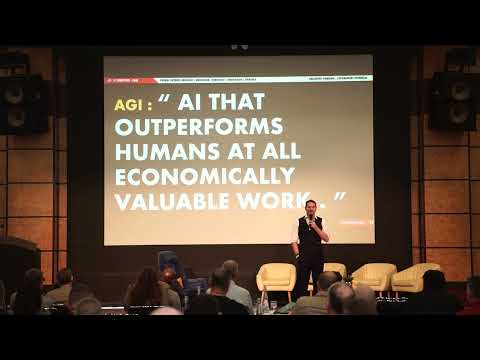
19:07 So when we say AI is an exponential technology, it's accelerating very rapidly. It's developing new capabilities very rapidly. And your problem is trying to figure out what the new AIs do, what they do for you, and why you should care. and then how to use them. Now by the end of the decade we think we will have proto artificial general intelligence. So this is when AGI or AI the definition of which basically according to Microsoft and OpenAI an AGI is an artificial intelligence that can generate 100 billion with a B dollars of profit by itself.
19:57 OpenAI's definition of AGI at the board is an AI that is capable of outperforming all humans at all economically valuable work. And we think that they will have an IQ of about 1,600. So when you think about your companies, if you aren't making a step change in what you do, how you do it, how would you use a system that has an IQ of 1,600 to 10 times your sales to beat all of your competitors?
20:41 These are the sort of problems that you actually have. So consider this. Through these artificial intelligences, you increasingly have free access to intelligence. Free access to intelligence. access to intelligence for almost no cost. That's an advantage because with the things I'm talking about. I don't expect you to spend thousands or tens of thousands of dollars doing this stuff. You can do this now. Your kids can do this now.
21:51 You can do it now sitting here for no money. You also have access to free knowledge. So Google democratized access to information. AI is democratizing access to knowledge. What do you want to know? What do you want to learn? Ask. It'll help you. You want to understand basically how a CFO in one of your target clients thinks and what they care about and everything else. Ask it.
22:26 It'll tell you because it's been trained on all of the publicly available information on the planet. Free expertise. I'm not Warren Buffett, but tell me how Warren Buffett chooses his investments. If I had to get inside the head of Warren Buffett, what sort of things would I discover? Because these AIs have been trained on every blog, every human psychological piece of research on the planet.
Chapter 6: The end of T-shaped individuals
23:05 So you also end up having the end of T-shaped individuals. The way that your organizations are aligned is you have a salesperson in the sales business area because they are an expert in sales. You have a legal person in the legal business unit because they're an expert in legal. You have someone in the IT department because they are an expert in cloud deployment, whatever it happens to be.
23:32 How many of you can program and write software? Okay. Excellent. Excellent. Excellent. Why didn't you all put your hands up? You can go to Anthropic now and you can say, "Write me some code. This is the application I'd like to write." And it's not quite there yet. You still need some expertise and everything else. But increasingly you are all able to develop and deploy software. How many of you are lawyers?
24:05 Yeah. Go. If I gave you a piece of new EU regulation that was 50 million words, how would any of you figure that out? You take the document, you take the 50 million word contract or regulation from the European Union on plastics, for example, and you say, "This is what I care about. Tell me the things I should know that come out of this documentation." You all have that ability. How many of you know how to write a fantastic pop song?
24:45 You're doing very good. So definitely not T-shaped individual. Using AI, you can use AI to create art, to create music, to create software, to create games, to create project management plans, to create presentations. Increasingly, you are not a T-shaped individual. You are multi-skilled. So from a company perspective, what happens when the salesperson can put together the business plan, the marketing strategy, can put together basically all of the video, the promotional videos that they need to sell something to a customer, can develop the product, can write the software, can sort the contracts out, and then how you use artificial intelligence matters.
25:39 So, I'll go through this. It's not always just about the kind of AI that you use. It's how you use it. And AI also mirrors the user.
Chapter 7: Strategic use of AI
25:58 So did you know if you asked an artificial intelligence a question whatever the question is and it was you asked it in a basic way like a 101 level way it will answer you in a basic way. So for example, tell me about Lithuania. Basic answer. If I ask that same question, but I ask that same question in the tone of a PhD level expert in Lithuanian economics, it'll answer me with a PhD level answer.
26:42 So this is where investment in staff matters because when you're using these AIs, if you use them in a basic way, you get basic answers out. If you use them in an expert way, I want to develop the way that you use the AIs matters. The way that you create the questions matters. Now, from a sales perspective, but also basically from a company perspective, we've got three approaches.
27:11 You can use artificial intelligence and robotic process automation to automate parts of your business. That's fine. You're going to do this. You're already doing this, but that's tactical. Automate the parts of your business that actually add relatively low value but that have high friction. Automation is tactical. The real benefit that you can get is amplification. So for example, if you automate a salesperson, you're reducing your cost of sale and you might grow sales revenues by, let's be kind, 20%. Right? So you've automated a salesperson or customer service agent.
28:02 Basically, you've dropped your company cost, you've grown revenues, but by 20%. What happens basically when you actually use these technologies with everything that they deliver to amplify the skills of the people within your business. I'll give you some examples.
Chapter 8: Amplifying business performance
28:27 So from a sales perspective, because we're sort of focusing a little bit more on sales now, you can turn them into super salespeople. I'm going to show you how. But then you can expand. So here's an idea. You've automated part of your business. You're using new technologies to amplify the skills and the people within your business. Your people can do more with less.
29:00 So, how aggressively do you start expanding into new markets? Because if you can do more with less, why are you just selling to the same markets that you were before? Why aren't you expanding aggressively? If you can, for example, create sales materials, sales products, and you can do that faster and faster and faster, then why aren't you taking business outreach from 10 customers a day to a 100 or to a thousand?
30:01 These are step changes. Now, these are some of the examples. So, artificial intelligence collapses the advantage of scale. So, if you think about all of the biggest companies that you're up against, all your biggest competitors, they aren't using technology in the right way. They don't hustle. They're highly bureaucratic. They aren't doing step changes in thinking. They're thinking incremental. They're generally automating, not amplifying, and they're slow. If you hustle like a bunch of entrepreneurs, I guarantee basically you can dig the foundations out from every single one of your competitors.
31:10 Am I a big company? No. But I know what I'm doing. And then I'm using technology to amplify what I do at global scale. Learning and development.
Chapter 9: Accelerating learning
31:31 So if you understand who your best salespeople are, what their hard skills and soft skills are, you can use an artificial intelligence to create an equivalent training and learning and development plan to upskill your junior salespeople to the level of your best salespeople. And you can generate those training plans for free at an expert level if you know how to use the AIs. So I'll give you a challenge because some of this you won't believe. Okay.
32:24 After this session, think about something that you would like to learn. go to the AI and say, "I would like to learn about this topic, but I'm not sure the best way to learn it. Help me." And the AI will say, "Well, what are you interested in?" And it will start helping you learn. It will understand the best way to help you learn. And if you say, "Look, you're teaching me something and it's, I just don't understand it. It's too complex.
32:56 Tell me about this subject that I want to learn in the style of a 20-year-old or a 10-year-old. You can learn about quantum mechanics. You can learn how to become the best leader possible. You can learn about human psychology, project management, software development. Doesn't matter what it is. You're tapping into a thousand experts.
Chapter 10: Data and listening systems
33:24 Now in terms of preparation from a company perspective when we think about technology stacks data is king. Do your companies have a data flywheel? The more information that you get in the more you analyze the more you get out. If you don't have a data flywheel investigate it ask AI what's a data flywheel. Take a picture and say tell me about this and say I'm this kind of company this kind of business. These are my target customers. How do I create a data flywheel that will 10x my sales listening systems? If all your customer communications are coming into one system, then those systems basically can on the one hand identify sales intent, but also if they're listening out basically to social media.
34:37 So, use AI. So bring in internal and external information into these AI systems to listen for buying signals. These buying signals can be very subtle. So for example, if you took a photo of this, yeah, then that's a buying signal because I could now say, "Right, you took a photo. Should we have a conversation about that later? Here's how we do it." closed loops. So how many leads do you have coming into the business that are then passed down different sort of parts of the organization using agentic AI you can have a lead coming into the business and you can actually close the loop so everything gets closed we know how many deal 30% of deals die because someone didn't do something someone didn't respond in time
35:39 or whatever it happens to be competitor intelligence So
Chapter 11: Advanced sales techniques
35:49 think about a competitor in your space, big one, little one, doesn't matter. And say, generate a SWOT about my competitor. But it's how you use these AIs. Tell me why my competitor wins. Tell me why my competitor beats me. Tell me what makes my competitor special. Tell me why my customers prefer my competitor to us. Right now this, tell me how my competitor thinks. Tell me where my competitor is focused.
36:34 and then say if I wanted to beat my competitor in Vilnius, tell me how I would do it. Give me five examples that I could use today to try to disrupt my competitor's business in Vilnius. It's not necessarily about the tool or the technology. It's about how you use it. Perfect targeting. I sell this kind of product. Who is my perfect customer? Tell me about their demographics, their income, where do they live, what neighborhood are they actually in?
37:36 Who aren't my customers? If I'm selling this product, who's not going to be a customer so I don't waste time. How you use these things matter. Pipeline analysis, you bring all the data in, and this isn't machine learning stuff. You bring all the data in and you say out of my pipeline, how much do we think's going to close, but you can infer because AI can pick up tiny buying signals. So, it can say, "Well, this deal, it looks like you're going to lose it because John said, "I really like your products, but" and then just that was it. He said, "Well, in order to convince John to buy my product, give me some recommendations. What should I do? Give me some suggestions." Well, get a manager involved. Basically, go and see him, pick up the phone, drop
38:37 an email. We think based on his previous communications, he likes this product because he was very enthusiastic about the meeting that you had with him. But when it came to this session, he didn't like it so much. You can infer based on inference, based on the psychological language within emails and communications. Who do I think's going to buy? Who's not going to buy? How can I mirror their psychology? How can I get them to trust us? What are the things that we do? Generate it. Intent sensing.
39:11 Like I say, you know, there's lots of intent. You know, taking a photo basically of the screen signals an intent. You're interested in something. Maybe I'm not quite sure what, but I've got a bit of a signal. Natural language. This is the other killer thing with artificial intelligence. You want to speak to these AIs basically in Lithuanian or in German or in Finnish or Icelandic where or you know where I was recently.
39:44 They speak 136 languages. You want to target the German market but you don't speak German. This will translate everything. This will tell you basically who to sell to in Berlin. This will tell you the kind of culture of the Germans. This will tell you how to change basically your sales tactics and your sales materials to target people in Berlin. It's how you use it. And then we take all this information in and then we continuously improve the sales process.
40:21 We find out what's working, where we're weak. We continuously modify and optimize.
Chapter 12: Implementing automated sales
40:29 And then finally, go time. So decide what to automate and then augment the rest. Increasingly using artificial intelligence, one individual salesperson can be running their entire team. They can prospect, qualify, sell, and close all by themselves. You can do a lot more with less. 24/7 sales. constant outreach, constant pricing, constant approvals, instant quotes. If a customer says, "Well, I think this is a little bit too pricey." The AI systems can instantly reprice all of your deals accordingly.
41:10 They can write the contracts, modify the contracts. Customer mapping. Who are my best based on what I do, what I sell, the industry that I'm in, the country I'm selling to. Who are my best customers? Who could be my best customers? Who am I missing? Mine and analyze all of your data. Your data is your most valuable asset. Treat it like one. AI is gathering 165,000 data points on individuals.
41:49 The devices you use, your psychology, your demographic, your emotional state. If you scroll with your phone really slowly, it knows you're a bit depressed. So, what do you do basically with a system that can understand your customers from 165,000 different ways? Buyer signaling. We sort of discussed that. I'm not quite sure, but to whether I really want to buy something. Well, you didn't say no. How do we convince you? negotiation. I'm not an expert in negotiation, but AI can help you become an expert in negotiation.
42:31 Hyperpersonalization. Every single email, every single communication, every single call, every single cold call can be highly personalized to your customer. You can do something called psychological mirroring. You all behave and talk in different ways. Using AI, I can pick that up and I can mirror that so we can build trust faster. And when we think about trust, isn't sales all about trust? The reason I bought from you is I just felt it was better deal scenarios. If I ran a deal like this, am I likely to win it or lose it?
43:13 Well, based on John's personality, you're going to lose it. This is how you modify it. You can run loads of deal scenarios. Influencer mapping. I'm selling to John, but who else within the organization am I missing? Who else makes the decisions? Who is an influencer? Well, based on LinkedIn data, based on social media feeds, based on company reports, you're missing these five people. Role play. I'm going to be selling to John. I'm going to be selling to John. John is the CFO of, I don't know, whoever, Exxon.
43:55 Help me roleplay my sales process with him. And it'll say, well, John likes this. He likes this about your proposal. He probably won't like this. He doesn't like that language. He wants you to talk to him about the money, not about the benefits. Customer role plays. Competitor role play. I am my competitor. I'm trying to sell to John. How does my competitor sell to John? This is how we think they sell. How do I beat them?
44:34 There are faint buying signals in here. What do I think I can do to get the customer just to tip over and buy stuff? What are the things I'm missing? What are the ideas I haven't thought of that could get John to buy? Well, you haven't thought of this. Here's an approach.
Chapter 13: Final call to action
44:55 So, here's the call to action. I would encourage you all to pretty much forget how you do business today. You have access to artificial intelligences that give you access to genius level IQs in a thousand different subjects. Free knowledge, free intelligence, free expertise, and free skills. If you know how to use these AIs, you can take down your biggest competitors. And what's more, they won't see you coming.
45:32 So, think about step changes, not incremental changes. And thank you for listening. Take care. Thank you. Matthew Griffin from the United Kingdom.