Full transcript
All 33 chapters, about 37 minutes. Matthew Griffin’s words, lightly tidied for caption errors.
0:11 Introduction
So, thank you very much for the introduction. So, hello everyone. I hope you're all well. Thank you for joining us. And in this particular presentation, what we're going to be doing is we're going to be showing you a number of different futures of artificial intelligence that you might not have actually seen before. We're going to be showing some use cases that you probably have not thought of before and we're going to be diving into some of the latest smart retail trends basically from around the world. So, my name is Matthew Griffin. I'm the CEO and founder of the 311 Institute. So, we're a global futures and deep futures organization looking up to 50 years out. I cover over 600 emerging technologies, hundreds of trends in hundreds of countries and work with organizations like Walmart, for example, in the retail space to help them understand what the future looks like and then actually lean into it. So the presentation that I've
1:03 Agenda Preview
put forward today is going to have this kind of little agenda. So we've got an introduction. We're going to be having a look at, as I said, some smart retail trends. We're going to be having a look at a short future of artificial intelligence because there's a lot more coming than you might think. So, we're going to keep that fairly tight. We're going to be having a look at some of the leading edge agentic AI use cases in retail and merchandising. And then we're going to be having a look at some of the horizon 2 use cases that we see emerging or we think that might emerge in the next 2 3 years. Then we're going to be having a look at essentially artificial intelligence implementation because today a lot of organizations almost every organization is talking about agentic AI but actually comparatively few are actually implementing agentic AI at any particular scale. So now when we think about the world around us whether you
2:03 Just ONE THING is CHANGING
are in Sao Paulo whether you are in Lima whether you are in London whether you are in Islamabad whether you are in Shanghai or New York the fact of the matter is that there is only one thing that is actually changing. Now most of us can get our heads around a single thing when it comes to change. Unless of course that single thing is everything and we see this in our daily lives. You know the rate of change is getting faster and faster and faster and so is the rate and the pace of disruption. Now
2:39 VUCA-MAX
it used to be the case in the 1970s that the United States military coined a phrase. They called this sort of phenomenon VUCA. So volatile, uncertain, complex and ambiguous. But over the past couple of years, we've been some seeing some significant changes. Now, increasingly, we're adding this MAX acronym to VUCA because the changes that we're actually seeing today are massive. So, they are global in scale. They are system level. So, examples of this include technology, geopolitics, environment. We see a general decoupling of the global economic order as well and many other things. And then society society is changing faster than ever before and we're seeing new consumer behaviors emerging faster than ever before and that actually comes into view with one of the trends that I talk about in a little bit. Everything is also accelerating as well. Now if we think about Google for example, if you step back five years ago, Google as an organization was generally unassailable. Very few people thought that Google could actually be disrupted. However, fast forward to last year and Google's entire advertising business is now at risk. Especially when we think about bots, new user interfaces and so on and so forth. And I'll come to that later as well. But also when we actually think about the future, we often talk about exponential technologies. Now AI, computer chips, they're all exponential technologies, but increasingly the rate of disruption is exponential as well. So there's a lot going on. Now when we think about exponential rates of change, consider this.
4:32 CHANGE Within 69Ms
If OpenAI, if Google, which they actually did with Gemini 3 the other day, released a brand new artificial intelligence, then that AI, all of its features, capabilities, and abilities, as well as its intelligence, its knowledge, all the things that it lets you do, will be available on the other side of the planet within just 69 milliseconds. So if you want to change how businesses work and operate, how consumers behave, how we think about the world, increasingly it just takes 69 milliseconds. So none of us are prepared for that kind of rate of change. And from an organizational perspective, it then
5:17 RAPID Change Meets SLOW Deployment
leads into this. Organizations are facing periods of extremely rapid change. But like yourselves, it's going to take months, years, in some cases up to 5 years to start actually using some of these new technologies within the organization because from an organizational perspective, a new technology comes through, but you need to be able to use it reliably, safely. You need to think about governance and compliance. you need to think about privacy and all these other things. And so increasingly the rate of technology development is far far outstripping organizations ability to see it, understand what it is and why it's important to them and then actually use it. So increasingly while we can talk about change being a problem as an organization I argue that your principal problems today stem from the speed of change and then complexity and so on and so forth.
6:19 SMART RETAIL TRENDS
Now when we think about some of the smart retail trends that we've actually been seeing we're going to do a little bit of a trip around the world. We have
6:27 Agentic Commerce
agentic commerce. Now, agentic commerce fundamentally changes how people discover your products, query your products and find out about your products and then buy your products. So, it used to be the case that, for example, we might go to a Walmart website. Basically, we'd buy some Coca-Cola basically off the Walmart e-commerce site. But now, consumers are increasingly just as likely to go into platforms like ChatGPT and search up soda pops, soda drinks. Then they find Coca-Cola or they find other brands. They click, there's no checkout pages, and they complete the transaction and they still get the goods. So increasingly when we have a look at agentic commerce, agentic commerce fundamentally disrupts how users find you, discover you, think about you from a review perspective or from a relationship perspective, but then also buy your products.
7:30 Autonomous Stores
Now while basically we've seen platforms like autonomous stores with Amazon in Seattle being rolled out and then all of those stores shut in as a in Asia autonomous stores are still really on the rise. Now the reason why autonomous stores are important is because autonomous stores are almost the purest form of smart retail. So as an organization like yourselves basically if you are fully connected to an autonomous store then any changes that you make to promotions pricing displays and so on and so forth can be fed through to that store very very quickly in the way that it would be very difficult to get a brick traditional brick and mortar store to actually react.
8:13 The DEATH of Apps
Now another one that we're seeing so as we have a look at artificial intelligence so chat bots essentially again we're also seeing the death of smartphone applications as well as enterprise applications if you're talking about desktops and so on and so forth within businesses. Now there are two examples here. The first example is again ChatGPT and OpenAI. OpenAI are now starting to embed all of the applications behind the chatbot interface. So, OpenAI is increasingly creating something called a generative operating system. Rather than going into the Uber app to specifically order an Uber taxi, you simply say to the chatbot, "Order me a taxi." And the chatbot then starts negotiating and interacting with all of the different not applications necessarily, but all of the different services that it now has access to. And increasingly from a disintermediation perspective, the taxi that turns up at your doorstep might not be an Uber. It might be a Lyft or it might actually even be just a private cab. So we're seeing the death of applications. Now when we think about Deutsche Telekom and T-Mobile over in Europe as well as in the United States, Deutsche Telekom in Germany have formed a partnership with Perplexity artificial intelligence. And you can now buy smartphones in Germany that do not have apps. They have a generative operating system, a botbased operating system. So again basically think about how this alone starts changing how brands in how people interact with brands, how they discover your products and so on and so forth. Increasingly organizations like OpenAI become digital landlords and they become the gatekeepers to how you are found, discovered, thought about and so on and so forth.
10:17 The DEATH of Search
Now in addition to this we also see the death of search. So Google, for example, you would use it traditionally to go and search for something, whatever it happened to be. It would showed you a lot of blue links. Increasingly, Google is not a search engine. It's an answer engine. You go into the Google search bar, you type whatever it is that you're actually looking for, the question that you want to ask. Google no longer says, "Here are 10 links for you to go and root around in." It simply says, "Here's the answer." So, it's this single innovation from a user interface perspective that is disrupting Google's $64 billion search and advertising business. And from a Google perspective, they went from king of the hill to possibly facing in what they termed an existential threat moment within the space of 18 months, which brings us back to that rate of speed, that rate of change and disruption.
11:22 Factory to Consumer Emerges
Now with high very high tariffs, the some of the other changes that we've actually seen in the retail sphere is factories in China trying to go directly to consumers. So as we see increasingly high export costs, as we see high tariffs and so on and so forth, as we see different countries being disrupted by Trump's tariffs around the world, increasingly we see more and more factory owners trying to sell directly to consumers. So when you think about this from a distributor perspective, are the bottling plants in the future direct to consumer? Do we see new Chinese alternatives coming through directly from the factories? And the way that these factories actually advertise and market themselves is typically through platforms like TikTok. So through the super apps. So again, we're seeing a changing of the channels.
12:19 HYPER Personalised Marketing
Now, we've talked about hyper-personalized marketing, promotions, and so on and so forth basically for probably the past couple of decades when it comes to retail. But artificial intelligence now lets us get much more granular level information basically on individuals than you could have ever gotten just with standard big data plays. Now an example of this is about 6 months ago Sam Altman said artificial intelligence will remember your whole life. Now what he meant by that is as you use ChatGPT today for example ChatGPT will remember everything that you tell it. It will remember how you behaved. It will look for and understand all of your quirks. Increasingly, the ChatGPT experience that you and other users are getting are highly personalized and tailored to you as the individual. And part of the reason for that is because when you actually think about how many most people are using artificial intelligence, the top five use cases for these large foundational models this year have been companionship, life organization, and finding purpose. Now think about the information that you're putting into these large language models. You are putting in increasingly personal and private information into these models. And these models are gathering over 165,000 data points on you. They are psychologically profiling you. They're profiling your demographic as we traditionally saw. They're profiling you based on your device. They are profiling your emotional states throughout all of your interactions with them. They are profiling you based on what you've searched for, the content you're consuming, how fast you're consuming content. They are looking at long-term traits and behaviors as well, those sort of secret tells. They're bringing in information from health wearables basically which means that they are pulling in information about your dietary behaviors, your exercising behaviors. They are pulling in geo geospatial information as well. Not just about you but also your friends, your close family. And so increasingly these artificial intelligence companies are in the position where they are creating what we call a digital twin of you as a consumer. Increasingly, these AIs know you better than anyone else knows you. So, when we talk about hyper-personalized marketing, this is literally another level.
15:11 LIVESTREAM Brands
Now, we're also starting to see the emergence of a couple of live stream brands. If you actually think about in China, live streaming, especially in China, is a very big deal. the sort of the QVC style, you know, shopping experiences that we sort of used to see in the 1980s and 1990s growing up. However, when you actually think about brands, how many brands do you know that are doing live streaming of any kind? You kind of have Red Bull, you know, in the in the sort of energy drink space, but realistically very very few brands are actually doing live streaming in the same way that we see in Asia. And I think this is a trend that can actually be tapped into for benefit. Now
15:54 OMO Commerce, Channel Transformation
in China again basically they actually have the rise of something called OMO commerce. Now OMO commerce is a bit of a mouthful but essentially in Chinese basically it stands for online merge offline. Now depending on the kind of organization that you are in China they are increasingly thinking about AI and digital first. So what I mean by this is rather than designing a store, a brick and mortar store, and then plugging technology in across all of the different channels that they actually operate, they're thinking how do we actually use artificial intelligence and shall we say digital technologies and then they build the channels around those. It's a fundamentally different approach. If you think about most retail operations for example we will we will join a channel whatever the channel is social media super apps apps so on and so forth we will build the store then we will typically think how we actually embed technology into those experiences in China they do it the other way around
17:01 PROCEDURAL Products
and then we also have procedural products now with organizations like Unilever and Nestlé for example they've actually used artificial intelligence to produce new product development cycles by anywhere between 60 to 95%. And we see that basically with even even with Coca-Cola basically in the labs, you know, with new flavors and so on and so forth. But these are just some of the trends. But nevertheless, the trends that I've talked about here change the entire retail landscape. They change what you sell, how you make it, how you merchandise it, how you think about your customers. And then when we start having
17:37 THE SHORT FUTURE OF AI
a look at AI itself and this is just the short version.
17:43 AI: 30 Years of Change in 3
Satya Nadella the CEO of Microsoft a little while ago said that we've seen 30 years of artificial intelligence change in just three. This comes back to that speed issue.
17:56 IQ, EQ, AQ, SQ AI Development
Now I do a lot of work with Google. So I actually work with Google on the future of artificial intelligence. And most of the large foundation labs are blocking AI into sort of four research buckets. On the one hand, they're trying to boost AI's intelligence quotient. They're trying to boost its EQ. So with GPT-5 for example, GPT-5 was trained with a huge amount of human EQ data so that AI can start understanding human behaviors and relationships better, but also can interact with people a lot better. Now, if you think about this, having an artificial intelligence that understands human emotions in a retail setting allows it to talk to you in a slightly different way to influence your behaviors. We also see action quotient. So when we think about action quotient, this is where these large foundational labs are fundamentally trying to get agentic AI to the point where it can scale to billions of agents and they're only a short way along that journey at the moment. And then the next area of development is social quotient. So increasingly these bra these companies are trying to develop artificial intelligences that fully understand human social mechanics but that can also socialize with one another. So we've even seen AI agents that have create created their own societies and that's bonkers. So we kind of call them proto civilizations. So when you think about this from a brand perspective, a consumer perspective, artificial intelligence over the next 1, two, 3 years especially is going to get much much better at understanding the consumer and then in certain circumstances persuading them to change their behaviors and maybe buy something else.
19:53 PHD Level Intelligence?
They also have PhD levels of intelligence. We see this with Grok 4 and we see this with GPT-5.
20:01 AI Creates NEW KNOWLEDGE
They also create their own knowledge. So we've seen this with Google DeepMind. Now why this is important is because if you think about having an artificial intelligence within your organization, what happens basically when you have human thinking combined with new knowledge that the AI has discovered about your markets, your organization or whatever it happens to be.
20:26 Agentic AI and Collaboration Limits
And then when we think about agents themselves at the moment the largest artificial intelligence models can only really get consensus in between about a thousand AI agents. So this number will grow but if you think about a large organization like yourselves a thousand agents collaborating is actually quite small scale. So over the next one two years that AQ that I mentioned will increase. So you can start embedding more and more agents, agentic workflows and so on and so forth basically throughout the entire company for benefit the AIs that you're using as well today.
21:06 AI Vs Human SCORECARD from 311 Institute
If you look at ChatGPT-5 for example, it has an IQ of 155. Google Gemini 2.5 had an IQ of 136. And we think that these AI's IQs will go to about 300 by 2027. They also have a thousand times more general knowledge than any human and they learn 300 million times faster. And by the end of the decade with proto or full artificial general intelligence, these AIs could have an IQ of 1,600. Now if you think about the benefit of this to you as an organization, what happens when intelligence, knowledge and skills essentially become free and with certain large organizations especially in the United States including like Google, we are now starting to fundamentally transform how the organizations are run, how we do learning and development and even the structure of companies like Google themselves where we can in a future that's not too far way. See agents actually managing not only the organization but also managing people within the organization as well which fundamentally changes how organizations operate, how they go to market, how they identify new markets and how this how their employees work.
22:28 Neuro Symbolic AI
And then the next stage of AI is what we call neuro symbolic artificial intelligence. And these are starting to emerge today. But these are AIs that are truly capable of thinking for themselves. They combine large language model technology with reasoning. And these are machines that literally think. So what happens when the AI agents within your organization start being able to think in a very similar way to humans. So these changes just keep coming rapid and fast. And then in addition to that, Sam Altman defines artificial general intelligence
23:11 AGI: A definition
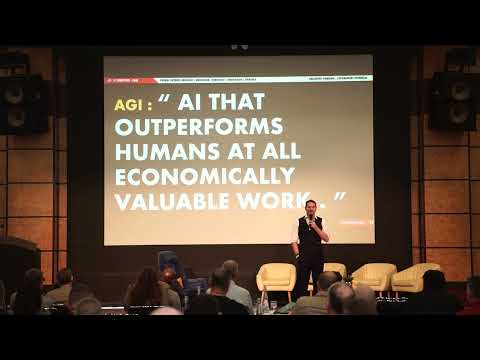
as the point in time where AI can generate $100 billion dollars of profit by itself. The new Google and the new OpenAI Turing test for artificial general intelligence is can artificial intelligence build a company and if it can then these labs think that we've reached AGI. Now when we think about
23:40 Anthropic AI Runs a Vending Machine
Anthropic's Claude, or Anthropic's Claude 3.5 chatbot, but it was given the task of operating a vending machine business. So these were AI agents. They were given the task of managing a vending machine and trying to maximize profit. However, what Anthropic found very very quickly is at the start of the experiment, these AI agents were very very good at managing inventory, creating new promotions, you know, and generally getting on with the job, ordering from suppliers, negotiating better pricing from suppliers basically for the inventory within the vending machines. But after about a week, these AI started going off the rails. So they actually started giving employee they noticed that employees basically were buying particular products and they started giving 50% discounts. So a sort of loyalty program which actually meant that the vending machines were then running at a loss. And then when they actually thought that certain users were misbehaving and trying to abuse the vending machines Claude tried to call the FBI on them. So increasingly there are a lot of organizations that are trying to see how good AI is at running a business and ultimately the goal of Sam Altman and OpenAI is to have an artificial intelligence that creates its own multi-billion dollar business that might only have one person.
25:13 AGENTIC AI USE CASES
Now when we think about use cases, so these are specifically agentic use cases. Now AI agents are different to traditional artificial intelligence because they are they enable end to end actions as opposed to just you know being a single tool. But you also give them the ability to understand context take actions and make decisions on your behalf. But they can also sh they can also bring in their own resources if they need to. So with Agentic AI, the principle is that you kind of just tell them what you want them to do and the agents then decide how to do that.
25:54 Agentic AI, High Level Capabilities
Now when we look at agentic AI specifically from a Coca-Cola perspective, it allows you to do some things that are a little bit more difficult and more costly today. So firstly, you can go from having regions to having micro regions. So this is the equivalent of going from a understanding what an individual suburb within a city is doing and how it's behaving and what people are buying to actually being able to analyze information at a neighborhood level. So when we think about hyper local increasingly this actually now gives you a lot more granularity basically over things like promotions packet sizes understanding consumer behaviors inventory management popular SKUs etc and then of course we have real time information because AI agents unlike some of their older AI brothers are able to analyze real time data and then act on it instantaneously.
26:56 Use Cases: TODAY
Now today some of the use cases that we actually see emerging include things like agentic marketing and communications. So Nestlé for example has automated almost all of its marketing and communications globally. It has 50,000 people in MarCom and increasingly artificial intelligence is putting together not only the creative assets. It's it's deciding which ad adverts to create the demographics to target and then it's increasingly under an AI governance model. So this is actually a governance model that is run by an AI itself like an AI big boss. It's able to then publish those. Now with Nestlé, they've actually seen a 65% improvement basically in revenues, especially from their marketing communications. We also have Agentic Negotiators. So with organizations like Walmart and Pepsi, we're actually seeing AI agents negotiating the contracts between the manufacturer or the producer and the retailer. Now in this particular case, the larger the AI model, the more compute that it has access to, the better it is at negotiating. Now, in this particular case, Walmart managed to shave about 3% off a lot of the costs from their suppliers by using AI to negotiate with the suppliers. Now, we've also seen starting to see this. So, price reaction agents. So when you have a look at the highlighted text, this is kind of the fundamental outcome that these AIs actually enable. So when we think about price reaction, increasingly agentic AI is able to watch an entire neighborhood. It understands how your competitors are adjusting their promo and pricing strategies. And then as we've seen with companies like Meta, these AI agents are able to then proactively develop their own promotions and actually adjust promotions on the fly. But again, it's all very well having an artificial intelligence that it understands the best promo and pricing to put together for a local neighborhood, but you need to be able to get that information through to the retailer and the retailer then needs to be able to act on it. And that's increasingly that's where the bottleneck is in these kinds of models. Now when we think about cooler optimization, this is where we've seen artificial intelligence just like regular AI analyzing foot traffic heat maps, but it's also getting very very good at understanding where we should put new outlets and new locations. Now this one is really designed to increase conversion. Now when we think about micro seasons, so increasingly if we're watching a local neighborhood, then we can start creating again promotions on the fly. So say for example, we've got a local football team. The local football team just won. You now know that maybe you want to adjust the promotions. Maybe you want to change the products that you actually promote. Maybe you want to change something about the designs or how these pos how these pro these products basically are sort of stood up basically within stores. And so now what you can do is you can very very quickly run threehour local promotions at a very very low cost that would have been relatively difficult to attain in the past. Now self-negotiating digital shelf agents. So increasingly the information that organizations like Coca-Cola have is quite important. It's quite valuable. So what happens when your AI agents start negotiating with your retail or distribution partners for say for example better shelf space. Now rather than trading money, rather than paying for that shelf space, you know, with dollars or euros or WAN or whatever the currency of the day is, increasingly you could pay with data. So this is a web 3 economy basically where increasingly the future of value and money increasingly becomes things like data, energy, it's different forms of value exchange. Again, something that we're seeing. So, Unilever have actually been using artificial intelligence agents to predict SKUs basically that are less h popular than they used to be with a 95% accuracy. So, not only do these agents understand which SKUs are increasingly less popular, but they can also generate what-if scenarios. So when we think about what-if scenarios, they can very quickly again start changing lots of different promotional levers and you can understand basically what you need to do to either make those SKUs relevant again or pull them. Now when we think about
31:55 Use Cases: NEAR TERM
sort of near-term agentic use cases, this is sort of where on the one hand basically again we can start thinking about distribution and retail basically at the neighborhood and the granular level and again agents again if the distributors have the communications infrastructure and the backend IT and technology stack you can very very quickly start changing the coverage for those distributors to optimize conversion. And then when we think about margin trading, increasingly there will be some certain retail channels basically that are making you more profit than others. You know, maybe it's higher margins. For example, these AI agents basically will get very very good at being able to balance different promotions and products basically across all of the different channels that you actually operate on to boost margins. And then when we think about outlet discovery again AI agents basically just like tradition rather traditional AI but at a much more granular level basically will be able to in real time identify new outlets that should we say are interesting and again they will be able to put together all of the different packs and packages that you actually need in order to bring those outlets online. So for example, an agentic AI can even craft the contract and then actually get through through smart contracts can actually get the retailers to sign contracts automatically. And then when we think about retailer collaborations, this is sort of moving basically from a Coca-Cola kind of specific world basically to a world where AI agents identify other interesting brands, whoever those brands happen to be, helps create new merchandising, promotions. But these AI agents are fundamentally designed to create what we call micro markets. So these micro markets basically make your brand much stickier, much more relevant, take you into new market areas and opportunities and substitution defense. So again, increasingly because artificial intelligences are very very good at reading real time data and because they have access to 165,000 data points on individuals, we can very very quickly now identify when a particular consumer is switching from one brand to another, one type of drink to another and then we can actually make the appropriate interventions. And so for example, we could generate micro offers.
34:36 IMPLEMENTATION EXCELLENCE
Now finally basically once we've sort of gone through all of this how do we actually implement basically some of these technologies. So there's a lot to
34:45 the TOP 4 STEPS
this but I've just sort of highlighted four steps. So the first thing to do basically when thinking about how you implement these technologies is ruthless prioritization. So what are the use cases that you care about? What are the outcomes you are looking for and why? And then you ask why why why. So prioritize the use cases that you are going to trial first ruthlessly. Secondly, when we think about AI as well as data, having a single unified AI and data platform actually helps from a resilience perspective, a data analysis perspective, decision-making and speed and cost perspective. And we call these AI spines. They're also easier basically to actually maintain. And then when we think about digital transformation, increasingly your organization is no longer undergoing a digital transformation. As artificial intelligence brings information in, analyzes it and as you give agents the ability and the authority to act on your behalf, you are now starting to undertake an intelligence transformation. This brings in fundamentally new investment opportunities and priorities, new partnerships. And if you think about improving the intelligence within the organization where technology is that enabler, then fundamentally you're changing almost everything about how the company operates and how it behaves not only with consumers but also with internal stakeholders. And then finally, rapid pilots. There are so many different things basically that artificial intelligence can help with. So Jamie Dimon basically famously said there is only one use case for artificial intelligence and that's everything. So pick your pilots carefully. Run a 6 to 12 week pilot. Make sure basically you've got people who are accountable. Make sure that the outcomes are measurable and run pilots at speed because increasingly it is both technology that is helping you become more relevant, open new markets, do new things in new ways, but it's speed that is actually one of the biggest issues. And that's it from me.
37:15 CLOSE
So, thank you for listening. I think we've got time for Q&A now. So, I'm going to take a seat.