0:30 Introduction
So as Martin said, I'm a futurist. My background is I ran national security units basically for IBM I ran Atos' global cloud business so I kind of have that technology sort of background but I typically help organizations understand what the future looks like so you can kind of think of me as a map maker. Now, when we're trying to put together a map of what the future could look like or will look like, the next problem that organizations have is how do we get from where we are today to where we think we would like to be in 1, 2, 3, 5, 10 years. And you guys actually embody the VUCA world. Have you actually thought about the acronym for the company? I don't know if Martin's thought about the acronym for the company. CAVU. CAVU is VUCA: complex, ambiguous, volatile, and so on so forth. So you are literally arguably the embodiment of this VUCA world basically that we live in.
1:54 Complexity as Normal
Now, when we're trying to understand what the future actually looks like, it's fairly straightforward to say that today we live in one of the most complex business environments ever. We have huge political change, huge societal change, environmental change, but as you all have noticed, we also have huge technological change as well. And trying to navigate all of this is infuriating at best because once you think you get your head around it, everything is changing. Now, from my perspective, I write lots of different books. I cover over 600 emerging technologies where AI is just one and I cover hundreds of different mega trends. So to try to put across the complexity of our world, the trends that are impacting you directly and indirectly, I put together this little video.
2:48 Hundreds of Trends Emerge
Now when we think about all the trends on the planet, they all impact you at an individual level, a professional level, a company level, a sector level, a country level, a continental block level, a global level. And ultimately all of these when they combine and converge, we're trying to figure out what's the impact for us as individuals or as a company. Why should we care? And then what should we do about them if we get the chance to do anything about some of them at all? And it's an incredibly complex world. We've seen this with the United States. We've seen this with international cargo trade for MAG where we see cargo trade dropping by 70% depending on the country that you're in. When we think about the future of work, there's a huge amount of anxiety that's building up when we talk about the future of work, principally because of AI, and we'll cover that. When we think about aircraft, I was here about 6 months ago under this Concorde. We have Mach 16 aircraft already being prototyped with advanced detonation engines. So what happens to travel when you can move from one side of the planet to the other? If Elon Musk gets his way with rockets at Mach 25 and you can get from here to Adelaide or Cairns in about 40 minutes. The world is literally getting smaller and then we are connecting up the entire planet. So today about 4.5 billion people are connected and by the end of the decade anyone and anything that wants to be connected can be which means that from a market opportunity perspective today your market opportunity is 4.5 billion people tomorrow it could technically be 8 billion people depending on the path that you tread.
5:17 AI: The First Self-Developing Technology
Now when we have a look at artificial intelligence I'm going to show you some of the things you might not have thought about with AI. So as a futurist I kind of show warts and all and then we try to bring it back together figure out what it all means and what to do about it. So artificial intelligence unlike every other technology that we've ever developed is a self-developing technology. We have AIs that are optimizing themselves, designing themselves, evolving themselves, replicating themselves with companies like Google.
5:52 AI Bootstraps its own Intelligence and 'IQ'
That is a first. When we think about OpenAI's artificial intelligences, we trained them with data. They then started creating synthetic data and started bootstrapping their own intelligence. So when we think about AI in terms of deep learning and machine learning and all the other variants of artificial intelligence, we are fundamentally dealing with a brand new kind of technology with brand new paradigms and capabilities.
6:23 AI Generates new Knowledge and 'Alien AI'
When we think about knowledge, increasingly we aren't dealing with artificial intelligence. We're dealing with alien intelligence. Because just as humans take in two sets of information together and combine them to create knowledge, AI is now combining different data sets together, for example, in the scientific world to create new knowledge as well. So from a knowledge perspective, the cost of accessing intelligence, the cost of accessing knowledge is dropping to zero for everybody on the planet with an internet connection and a device.
7:06 AI: Ghosts in the Machine
Now, one of the other things we don't necessarily think about with artificial intelligence is a lot of the AIs that are on the market today have been trained on human language. And the researchers that I work with say we are no longer inventing AI. We are discovering what it can do. And one of the surprising things that we found with platforms like Anthropic, OpenAI, Google, Alibaba and so on and so forth is that as artificial intelligence has been trained on human language, it's picked up human behavior. If you want to hack some of the latest artificial intelligences, you use psychology, not traditional cyber weapons. AI is deceiving us. It's lying. It's hallucinating, which in human speak, you're just getting stuff wrong. So increasingly the artificial intelligences that we are developing have humanlike behaviors and humanlike psychology. So what happens when you start embedding these black boxes within the organization.
8:27 Agentic AI and 'HIVE Intelligence'
Now when we think about agentic artificial intelligence the next step forward there is an agentic framework called ADAS. So we are already seeing AI agents that are evolving themselves. They are organizing themselves. We are seeing system what we call system of systems coming together. So system of systems is where we have lots of agents over here coming together with lots of agents over here to do something new. But we're also starting to enter a new age of AI where these AIs are able to swap intelligence. So AI at scale is now starting to develop its own kind of hive intelligence.
9:15 AGI Statistics, Predictions
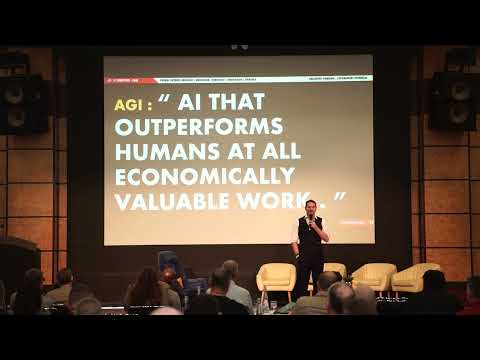
Now how many of you have used ChatGPT? Yeah, there you go. Now, ChatGPT in 2023 had a measured, so we studied it had a measured IQ of 155, which is the same as Elon Musk and Albert Einstein. When you're using ChatGPT, you have access to an AI with an IQ of 155 and a thousand times more general knowledge than any human. That Geoffrey Hinton, the godfather of artificial intelligence, described as a fundamentally superior learning algorithm to the human brain because ChatGPT does everything that it does with just 1% of the equivalent human neural network connections. As we start looking to 2026 2027, increasingly we start tipping towards artificial general intelligence. Now, it's estimated that AGI from companies like Anthropic and OpenAI and others could have an IQ of 1,600. It could have a billion times more general knowledge than any human. And increasingly, the knowledge that it has will be cross domain. And then of course bearing in mind that we are in this rate of technological change, we have quantum artificial intelligence already merging as well. So, as a technology organization, you're having to deal not just with new technologies coming through, but new technologies that allow you to do fundamentally different things that in many cases we've never actually even thought possible, let alone figured out how to embed this human brain basically into our business that's running on Einstein's quantum mechanics theory. This is difficult stuff.
11:19 MAJOR AI INFLECTION POINTS
11:28 Collaboration Between AI Agents
Now when we think about some of the major AI inflection points as they affect you again in recent studies we've tried to figure out how many AI agents can work together in the equivalent of the human gig economy to get stuff done. So it's generally deemed by psychologists that you can have a hundred people working together and get things done. But then once you tip over a team of over a hundred, consensus starts breaking down. It's difficult. This is why when companies grow beyond 100 people, structures change. Using the largest LLM models out there, we've managed to have a thousand agents working together to do tasks. And some of the things they've done have been quite stunning. The smaller the model, the fewer the agents there are that can work together.
12:23 The Future of SAAS and Agentic Software
Now, when we think about the impact of agents on we'll say enterprise software, but software as a service and so on and so forth. Firstly, the business models are changing, the interfaces are changing, the workflows are changing. So, we're going to start moving more to agent as a service. Microsoft is already talking about you accessing everything on your Windows device just with a single agent. We have agentic middleware which we've already in the national security space been able to hack. That's an interesting one. Generative apps. Again, if you step back six months ago, two years ago, there was a lot of talk, for example, with organizations like Accenture about AI building its own applications, and these would be generative apps. Increasingly, this brand new mega trend is already starting to fade into the background. When we have a look at enterprise software as a service, companies like Microsoft estimate that by the year 2030 between 40 to 50% of SaaS workflows will be agentic and agents require a fundamentally different kind of infrastructure. So infrastructure to support them and then we also have single agent interfaces. Now, single agent interfaces offer an opportunity for you, but also they're a disintermediation and a disruptive threat to you.
14:06 The App-less Future
If you think about your phones today, if you want to get something done, you go to an app. Yeah. You want an Uber, you go to an app. You want to order a TV off Amazon, you go to an app. Deutsche Telekom about two months ago partnered with Perplexity AI to create an app-less smartphone. There's no apps on this. You simply say to the phone whatever it is that you want it to do and agents on the app get it done. 22 hours ago, Amazon did something. So, how many of you have used Amazon? Yeah, pretty much everyone. When you go onto Amazon and you buy yourself a new TV, you do that via Amazon, right? The Amazon platform. Amazon 22 hours ago released buy with me. It's a single artificial intelligence agent. You converse with that agent. You say, "I want you to buy me a TV." And that single agent will have a look across every single site it has access to. A TV will turn up at your doorstep, but that TV might not have come from an Amazon marketplace seller. It's a disintermediation threat. So when we think about how agentic AI interfaces start disintermediating companies increasingly you will need to have the inventory. You will need to have a good cost associated with that inventory and you will need to be able to deliver that inventory whatever it happens to be at speed.
16:06 AI: Pricing and Platforms Business Models
Now from a platforms and pricing perspective increasingly as you've seen we're starting to see the end of truly monolithic platforms. So as we move more into the future but we see platforms connecting much more to decentralized services. So whether these are blockchain based decentralized applications and services and so on. But again this is a fundamentally different kind of architecture. In addition to that, if you think about the vast majority of services that you use, they are all generally subscription services. Netflix, for example, is a subscription service. As we see Agentic AI coming through, it looks like some companies will start charging a task based service, a task-based price. So, for example, rather than subscribing to Netflix and paying £13 a month, you just say that you'd like to watch the latest James Bond movie. It pulls that from the inventory, shows you that, and it charges you a microcharge, microtransaction. So, this alone starts disrupting some of the subscription-based pricing models for the applications that you use, the companies you use, and so on and so forth.
17:24 INTELLIGENCE Transformations and the 'Post-Digital' World
In addition to that, you've been going through a digital transformation since you were conceived as an organization. But as we see the rise of increasingly smart, sophisticated, and intelligent AI, are you now starting to undergo an intelligence transformation instead? Because you pull information in, these AIs analyze it and then you give them the power to act or decide on your behalf. Which also means that from a technology perspective, you are starting to move from being a company that automates different parts of the stack to a company where parts of the stack are autonomous. And there is a big difference between automation which is like robotic process automation and an autonomous company.
18:32 Autonomous And ADAPTIVE Organisations
In addition to that when we start looking two generations out bearing in mind that generative artificial intelligence is able to rewrite code on the fly. So it's now in the top 0.2% of expert coders globally. We think we can see this future. So today when things change outside or inside of the business, one of the problems that you might actually have is your reaction speed. You have to rewire the systems, you have to update software, infrastructure, whatever it happens to be. However, as generative artificial intelligence embedded within the business sees, for example, a regulatory change, in theory, it should be able to understand what the regulatory change is, what it means for the company, and then start changing on the fly your GRC systems. So we end up ultimately with organizations that are built different that can literally react almost in real time to internal and external market conditions. And again this is a different kind of infrastructure.
19:50 AI: Your Next COMPETITOR
Now I mentioned that we got agentic AI to do some interesting things. Now, what if AI without a human could build a competitor? What if I could do this?
20:15 AI: Building a #TikTok Clone in 30 SECONDS
So when we think about CAVU's moat, we have already seen the point in time. Now, this is Eric Schmidt. He thinks that in about the next two years, agentic artificial intelligence will get to the point where you simply say to it, "Build me a TikTok clone." The AI will understand what TikTok is, the markets it's in, the relationships it has, etc., and it will just write the clone and say, "Here you go. Here's a TikTok clone, complete with a reverse engineered algorithm." So, how do you protect your company in a world where any individual with a connected device can say to an artificial intelligence that has an IQ of about 1,600, clone this company? And then it just writes everything. Now, let's face it, if I'd put my name here, you wouldn't be believing me. But Eric Schmidt is quite well plugged into the artificial intelligence ecosystem basically within the US. So how do you maintain your advantage in this world? Or how do you use this to your advantage?
22:03 AI Builds a Multi-BILLION Dollar Company
That's the better question to ask. Now, who knows this guy? Anyone know him? Sam Altman. That's right. Now, 10 years ago, I was with Accenture and I said, "At one point, better we see artificial intelligences that build their own companies." [Matthew played a clip of Sam Altman on one-person billion-dollar companies.] So there are the changes that you see happening in the world around you and there are things happening that you might not appreciate. And at some point, these start getting closer to you as individuals and you as a business. But the earlier you can see them, the better a point of view you can get, the more opportunity you have to discuss and debate them and plan for them. There are opportunities, there are threats, but every threat is an opportunity. Now, when we have a look at the future workforce, there's always plenty of talk. There's always plenty of fear going around.
24:34 THE FUTURE WORKFORCE
24:34 AI: Automating #SKILLS FASTER
If you actually listen to any kind of news network, when we've done studies, we're finding that artificial intelligence is automating cognitive work up to 50 times faster today than it did 5 years ago. So we see artificial intelligence trying to come after blue collar jobs in the form of humanoid robots and so on and so forth, but also white collar jobs. Now it's very easy to think of this as a threat, right? Lots of people think about this as a threat.
25:11 The LIMITLESS Workforce
But we end up with two kinds of workforce. The first workforce, as Marc Benioff, the CEO of Salesforce says, is the limitless workforce, where we have almost an infinite number of digital artificial intelligence-based agents that are doing some of the work for us within a company. And some of these are even being managed by the HR teams now.
25:36 The UNLIMITED Workforce
But the other one is this. Now I think roughly what about 25% of you are in software development within the business. You can use artificial intelligence to do text to art and create beautiful pictures. How many of you are not software developers? Okay. Using artificial intelligence increasingly as AI automates different jobs, tasks, and skills. It democratizes access to those jobs, tasks, and skills for everyone else. You aren't an artist, but you can tap into AI to create art for the marketing department. You aren't a software developer, but you can actually start developing some level of vibe coding software. That's it. And the software devs will understand what I'm talking about when I'm talking about Vibe coding. You don't necessarily know how to put a legal contract together or review it, but AI can help you today. You are all T-shaped individuals. But what happens when the only two things that you have access to as individuals is all of the world's knowledge for free? And then all of the world's skills. Did you know what? I'll give you a new survey came out from Harvard today. Do you know what the number one use of ChatGPT is now? The thing that everybody types into it. The number one use case for ChatGPT today is people using ChatGPT to help them find their purpose and understand the world because these are fundamentally different times that we live in.
27:53 Achieve Vs Avoid
Now from an individual perspective you can think of AI or technology in one of two ways. You can think as the traditional media will want you to think, AI is coming for my job, right? That's an avoid. I do not want technology to take my job away. If you think in that way, you're thinking tactically. I'd also argue you're thinking wrong. But there is a reason to worry a little bit. What if you went the other way and said, "Well, using technology, what can I achieve?" How many of you are worse off for having access to Google just as a search engine? As these tools get increasingly powerful, your potential as individuals increases a millionfold. The actual problem that you have is you don't know what they are, how to use them, or how to use them to benefit you. Not necessarily the organization. That's a different place. You have a problem understanding if I have access to all the world's knowledge, all the world's skills, what do I do with that?
29:09 FUTUREPROOF Workforces
So increasingly from a workforce perspective, workforces that are using technology to augment employees are doing very well. But your soft skills, you need solid soft skills like we saw with leadership. Well done by the way. You need solid soft skills. That's mental resilience. That's adaptability, resourcefulness, empathy. All these kinds of things. Increasingly, your hard skills, the other reason why the company employed you, those need to be switchable. Because as we start seeing different tasks, different jobs going away because of automation. It's not that we don't have other things to do. It's that I was always an accountant. So, how do I move from being an accountant to being something else? It's estimated now that from moving on from here, the average person will have 14 careers in their lifetime. Not jobs, careers. So, if you are the kind of person that is mentally resilient, you're up for a challenge, you're able to learn quickly, you don't mind change and ambiguity, then actually the world is your oyster.
30:33 Career Management
But in addition to that when we talk about organizational resilience the best and the most resilient organizations today in face of this change move people around the business. You know today you're in this line of business next year you might be in this line of business then you're in this line of business. This is how you gain extra skills and extra relevance to the companies that you actually work for and want to work for. But we also can predict what's coming next.
31:19 Future Workforce Management FRAMEWORK
So, this is the way that we figure out the jobs of the future, what comes next, and what your skills should be. Firstly, the company comes up with a strategy. Fairly straightforward. The company determines its future state in five years time. What will CAVU look like? Who will we sell to? What products will we have? And so on so forth. Beneath that now you understand your future state. What people do I need? What jobs are there to be done? Once you understand the jobs to be done, what skills do we need? And this is where we can do two interesting things with AI. Now on the one hand, we can train you on brand new skills. Say for example, quantum data science, but we can also augment you. So say for example, these are the soft skills, these are the hard skills. Say for example, you need a better understanding of critical thinking. So you have a low score. You're great at everything else that you do, but you got a low score when it comes to critical thinking. Increasingly, we can use AI to help you increase this score. We know how to transition people from one part of the workforce to the other because we've done it and we're doing it at scale. And the way that we ultimately move you from a role that might be tailing off to a role that's accelerating and taking off, it's learning and development. All of you can learn, but we've managed to use AI to accelerate children's learning by 12-fold. We can get AI to develop courses and everything else. So as the world changes, you need to change as individuals as well at some point. And you'll know when that point is. But ultimately, you have a huge amount of potential within you. You shouldn't doubt your ability to change. The question is, are you held back by fear or are you hopeful of the opportunity?
33:43 Global Market Access
And then from a mindset perspective, increasingly as CAVU MAG talks about 67 million passengers this year, increasingly your customer base is 4.5 billion people. So it's how do you go after that? When we talk about new services, look at adjacent services, competitive pivots, customer exit points and technological advantage.
34:01 New Market Opportunities
Tech, it will be one of your strongest advantages from a mindset perspective.
34:08 EMBRACE Change
You need to learn how to embrace change. We don't like change because we don't know what it is. We don't understand it. I don't know who to ask. I don't know what the risks are. I've got no one to help me. There are plenty of people to help you with everything. And you've got to embrace ambiguity because there's a lot that we don't know about the future.
34:32 Move at SPEED with URGENCY
You've also got to be able to move at speed, whether that's moving at speed as an organization because something new has come in, new opportunity, new technology, new partnership, whatever. And you also need to act with urgency because there are lots of companies out there that increasingly are thinking, how do we land our Concorde on your turf? As you should be thinking, how do we land our Concorde, which we actually have on their turf?
35:06 Learn how to get things done
But fundamentally with all of this, once you've got your strategy, your plans, and everything else, one of the top tips that I get from the organizations I work with, learn how to get things done. It's all right talking about all of this. It's all very well developing a strategy, but learn how to get stuff done. Learn how to train yourself. Learn how to adapt. Learn how to do new things. Figure it out. And that's it.
And I think we have time for some Q&A.